Intelligence for the Generative Era
Move beyond the search box. Insights on GEO and securing your brand's visibility across Large Language Models.

ChatGPT Ads: Ads Without Keywords. What It Means
ChatGPT Ads have launched. They don't rely on keywords; instead, they focus on the context of the conversation, the landing page, and the client's situation. Based on data from 11 brand representation studies, we demonstrate why the success of a campaign hinges on an often-invisible layer in the advertising panel.

Entity Mapping Lacks Direction
Entity mapping organises products, audiences, issues, and sources, yet it fails to address which relationships are strategically most important for the brand. Why does a brand need not only a map but also a clearly defined direction?

Keywords are not entities. How to build content around what users actually mean?
Keywords reveal how people search. Entities, attributes and relationships explain what content needs to clarify. Learn how to connect both layers in a practical content model.

Citations are not influence. How sources shape generative answers?
A source link can show that your website appeared in an AI answer. It cannot show whether it shaped the decisive fact, comparison criteria or recommendation. Learn how to distinguish citation from influence in generative search.

AI visibility is not one metric. How to measure mentions, recommendations, citations and representation?
AI visibility is not one score. Learn how to measure mentions, recommendations, citations and brand representation using clear denominators, research panels and uncertainty.

How to run an AI visibility audit: presence, citations, hallucinations and stability
Learn how to audit AI visibility beyond mentions: test presence, recommendation role, factual accuracy, citations and response stability across generative search systems. A practical framework for identifying representation gaps and turning them into proportionate action.
GEO after SEO. What can actually be optimised in AI search?
Brands can optimise their information assets and access conditions. They can only influence retrieval, citation, absorption and recommendation. The GEO control surface provides a practical model for distinguishing controlled interventions from observed outcomes.

Brand Semantics Infrastructure: how to make AI Search understand your brand correctly
AI search does not simply rank pages. It decides which brands to recognise, cite or omit. Learn how brand semantics infrastructure — entity maps, claim maps, sources and representation testing — helps AI systems understand your brand correctly.

The "Right" Candidate: How AI Models Can Transform Local Elections – A Case Study of Kraków
GenAI models not only summarise information about candidates but also shape their public image. Through the research of Michał Drewnicki, I illustrate why a name alone is insufficient in local elections.
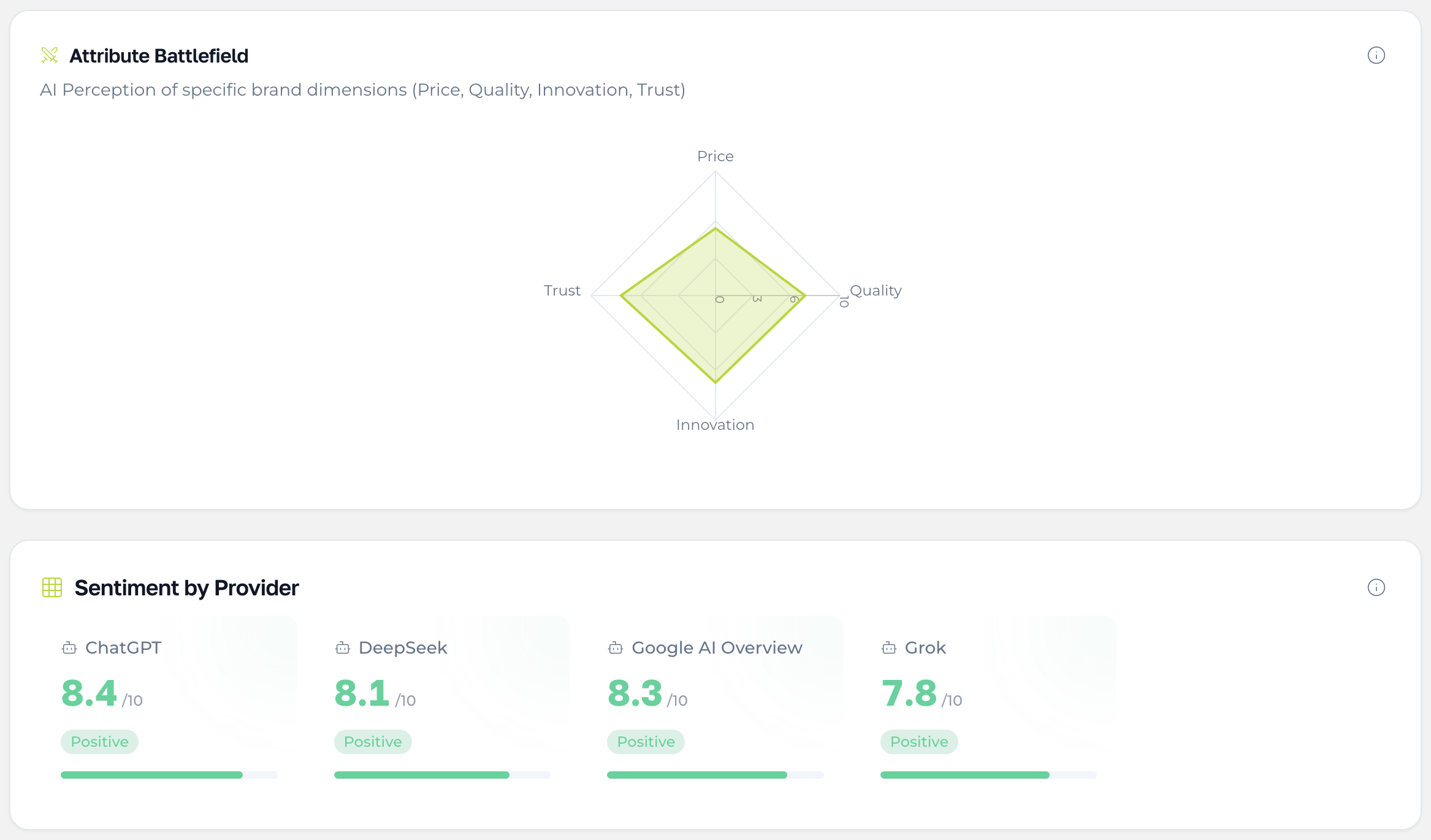
How to interpret and report an AI visibility audit
Learn how to classify AI search answers, verify claims and sources, assess stability, and turn audit findings into prioritised recommendations.

How to run an AI visibility audit across AI search platforms
Learn how to design and run a reproducible AI visibility audit across ChatGPT Search, Google AI Overviews, Perplexity, Claude, Copilot and other public AI search surfaces.

What should an AI visibility audit measure?
A practical framework for assessing brand presence, positioning, sources, factual accuracy and stability across AI search systems.

The Chicken, the Spade, and Your Favourite Chatbot: Why the Brain Lies to Justify Itself
What distinguishes the functions of the left and right hemispheres of the brain? What is the left brain interpreter, and how does it relate to the operation of LLMs? Discover more in this article!

How AI is Redefining SEO: Your Visibility Strategy in the Era of Large Language Models
Why is SEO losing its significance? Discover how LLMs are changing the standards of search.

What is LLMO? Key Concepts and Benefits for Business Implementation
Discover what Large Language Model Optimization (LLMO) is. Shape your digital presence so that AI can optimally interpret your content.

5 Key Differences Between LLMO and Traditional SEO
Large language models are redefining search standards. Discover the 5 crucial differences between LLMO optimisation and SEO.

How GEO and LLMO Work and How AI "Learns" Content
Businesses must grasp two concepts: GEO and LLMO. Without them, building brand visibility in 2025 will be impossible.

What is Semantics and Why Does it Determine Brand Visibility in the AI World?
Semantics has become a crucial element of brand visibility in the realm of generative search. It dictates whether AI algorithms understand what your company does, how they interpret its messages, and whether they feature it in zero-click answers.

How is SEO Evolving? AI-Driven SEO and Zero-Click Trends Redefining Brand Visibility (2023–2025)
Why must brands aiming for visibility on Google and AI responses rethink their language and content strategies?

What is the difference between an SEO agency and a brand semantics agency?
Is SEO becoming less effective? This is no myth. In the era of Google SGE and ChatGPT, brand visibility now hinges not on rankings, but on whether AI can comprehend them. Discover the distinctions between traditional SEO agencies and brand semantics agencies – and why the latter provides an uncopyable advantage.