
Just a few years ago, a voter wanting to check a candidate for mayor had to visit their website, browse through media (including "traditional" ones), watch debates, ask friends, or scroll through several pages of Google results. Today, they can often do something much simpler – ask their favourite chat (a large language model).
They don’t even need to… know any names. They don’t need to know who belongs to which committee. They don’t have to follow press conferences. Generally, they don’t have to do much. But they can. They can ask: “Who in Kraków has the best transport programme?”, “Which candidate is associated with Nowa Huta?”, “Who wants to change the Clean Transport Zone?”, “Does the PiS candidate have local government experience?”, “Who is specifically addressing the cost of living in this election?”.
And they will get an answer.
Not a list of links. Not a classic search result. Not a neutral document database. They will receive a synthetic description of the political scene, constructed by the LLM based on what the model finds, remembers, interprets, considers important, and arranges in an appropriate hierarchy. Tailored to the user who has, in part, “raised” their own “Tamagotchi” from the third decade (how does that sound!) of the 21st century. Only they don’t feed it or wash it by pressing buttons; they toss in bits of themselves that reveal their habits.
This is a new layer of the election campaign. Quiet, private, difficult to monitor and – in local elections – potentially very significant.
Kraków as a Laboratory for Elections in the Age of GenAI
Kraków is a good place to observe this change in practice. It is not a small municipality, but neither is it a nationwide campaign where every candidate is constantly present in the mainstream media. According to GUS data, by the end of 2025, Kraków had 816,614 residents. It is a large, complex urban organism: with a centre, Nowa Huta, peripheral districts, universities, tourism, business, transport, conflicts over green spaces, spatial planning, municipal service prices, and city management. source: Kraków in Numbers
Additionally, there is a unique political context. In the local referendum on 24 May 2026, the turnout for the vote on the recall of the mayor of Kraków was 29.99% — enough for the referendum to be valid and decisive. In the parallel vote concerning the recall of the City Council, the turnout was 29.97%, meaning the statutory threshold was not met. The difference is seemingly minimal, but the political consequences are entirely different. source: City of Kraków
Kraków also has recent experience of very close competition. In the second round of the presidential elections in 2024, Aleksander Miszalski received 51.04% of the votes, while Łukasz Gibała received 48.96%. According to reports based on PKW data, the difference was 5,434 votes. source: Rzeczpospolita
These are numbers that warrant caution regarding every new source of informational influence. Not because a chatbot “will choose the mayor of Kraków”. That’s too strong a claim. But because in a campaign where a few thousand votes can change the outcome, it also matters who is visible, who is overlooked, what they are associated with, and how they are described in the responses of generative artificial intelligence, which users are increasingly turning to.
The Voter Doesn’t Just Search. The Voter Converses
The most significant change is not that AI can generate an ad, meme, or deepfake. That certainly matters, but it is already a well-recognised topic. There is much discussion about it, and campaigns exist – more or less social. More or less funded by specific electoral committees.
A more interesting and less obvious change concerns the fact that LLMs are becoming private informational advisors. A voter may not ask: “What is Michał Drewnicki’s programme?”. They may not even remember that name. Instead, they might ask: “Who in Kraków has local government experience?”, “Which candidate talks about Nowa Huta?”, “Who has a specific, clear stance on SCT?”, “Is the PiS candidate in Kraków just a party member, or do they have local experience?”.

Such questions are much closer to the real decision-making process. People rarely compare entire programmes from start to finish. (By the way… which party in 2024 clearly described its election programme rather than riding the wave of changing polls, rally cries, and social media metrics?) More often, they seek answers to their own problems: commutes, prices, green spaces, schools, pavements, parking, construction outside their window, a sense of chaos in the office, or a lack of influence over city decisions.
Here, large language models begin to act as a new intermediary. They not only provide information. They organise the scene. They choose which candidates to mention. They decide which facts to consider significant. They condense complex contexts into a few paragraphs. And they often do this in a way that we won’t see in classic media monitoring, SEO, or social media analysis. Thus, one might infer that polling firms and their “misses” will increasingly become one of the main topics of commentary after exit polls.
This is No Longer a Technological Niche
If anyone assumes that “chatbots” are still a toy for students and the tech industry, the data quickly cools that view. According to the Gemius/PBI report, in June 2025, over 9.3 million real users in Poland were using ChatGPT. This represented 31.4% of internet users and 28.6% of the population aged 7–75. The report also indicated that among ChatGPT users, there is an overrepresentation of individuals under 35, with the average usage time in the 25–34 age group being 2 hours and 42 minutes in June. source: Gemius/PBI
On a European scale, Eurostat reported that in 2025, 32.7% of EU residents aged 16–74 were using generative AI tools. In the 16–24 age group, this percentage was already 63.8%. source: Eurostat
This is significant, because younger voters are also a group more inclined to use new informational tools and a group that often has less stable turnout in local elections. There is no need to assume a mass transition of the entire campaign to AI-supported systems. It is enough to notice that for a significant portion of users, conversing with a chatbot is becoming one of the natural ways to organise information.
AI as a Tool for News, Politics, and Decisions
Data from the Reuters Institute shows that AI chatbots are already being used for information consumption, although they do not yet dominate. In 2026, 10% of respondents across 45 markets reported weekly use of AI chatbots for news, up from 7% the previous year. Even more interesting is how people use them: 42% of news chatbot users ask follow-up questions, 35% use them to get the latest information, 34% for summarising, 30% for simplifying complex topics, and 33% for assessing the credibility of sources. source: Reuters Institute Digital News Report
This is almost a ready description of voter behaviour in a local campaign. “Explain to me what the Clean Transport Zone is about.” “Summarise the differences between the candidates.” “Who is credible on transport issues?” “Does this candidate really have local government experience?” “What sources confirm their statements?”
At this point, AI ceases to be just a tool for writing texts. It becomes an interface to public reality.
The Strongest Warning Signal – Voters Are Already Asking GenAI About Elections
One of the most interesting figures comes from a study on the 2024 parliamentary elections in the UK. A representative survey of 2,499 adults found that in the week leading up to the elections, 32% of chatbot users (13% of all eligible voters) used conversational AI to seek information directly related to their voting decision. source: arXiv, UK study 2024
This is not a marginal detail. It is a signal that chatbots are entering the heart of the electoral process: not as an abstract technology, but as a tool used when a voter is making a decision, organising arguments, or trying to understand the political scene. Often just before entering the polling station.
Importantly, the authors of this study do not formulate a simple alarmist conclusion. In a series of experiments involving 2,858 participants, they found that using chatbots did not worsen political knowledge; on the contrary, it increased it to a similar extent as traditional internet searching. source: AI Security Institute
And that is why the topic is more interesting than a simple tale of danger. Time for a truism. I’ll even bold it to make it more eye-catching. No need to thank me…
LLMs can help voters better understand politics. But they can also confuse, omit, oversimplify, inaccurately identify candidates, or create specific interpretative frames.
The Other Side – Chatbot Responses Can Be Flawed
The problem is that model responses appear organised, confident, and complete, even when they contain gaps. You know… like that future engineer (if fate and professors allow) from AGH you met at a student party, who will stubbornly defend a position that three beers ago wouldn’t even have entered the discussion ;)
A study by EBU and BBC covered over 3,000 responses generated by four AI assistants (ChatGPT, Copilot, Gemini, and Perplexity) in 14 languages. 45% of responses contained at least one significant issue, 31% had serious source problems, and 20% contained serious accuracy issues, including outdated or hallucinated information. source: EBU/BBC
In local elections, this risk may be greater than in a national campaign. Local sources are more dispersed. Candidates may be (and are, as we will soon prove) less known. Context changes more rapidly. Names from the previous cycle may mix with new candidates. Programmes may be published in stages. (if they are created at all, but I’ve already written about that and won’t poke any more jabs… for now) And user questions are often short, colloquial, and imprecise.
With a national leader, the model usually has plenty of data. With a local candidate for mayor of Kraków, it must piece together a picture from the BIP, local media, the candidate's website, social media posts, polls, reports from conferences, and current events. These are ideal conditions for seemingly minor but politically significant errors: confusing roles, omitting competitors, attributing outdated candidacies, assigning someone too narrow a label, or basing responses on sources from previous elections.
The Most Important Twist: GenAI Doesn’t Have to Lie to Influence
In the discussion about AI and elections, too much attention is focused on “fakes”. Meanwhile, for a local campaign, something subtler may be equally important: representation.
The model may not provide false information. It may simply describe the candidate mainly through their party, omitting their local government experience. It may mention them when asked about PiS but not when asked about transport. It may write about SCT but skip the topic of public transport. It may respond to a question about Nowa Huta without indicating the person who builds part of their communication around connections to that part of the city. It may place the candidate at the end of the list, even though they are formally one of the significant participants in the race.
This doesn’t have to be a “mistake” in the simple sense. It may be a consequence of the hierarchy of sources, the freshness of data, the availability of information, the way a question is phrased, and the mechanics of the response generated by the model.
In traditional SEO, one fought for position in search results. In the world of LLMs, the question becomes increasingly important: does the candidate even appear in the response, under what questions do they appear, what are they associated with, and who are they compared to.
This mechanism is clearly visible in Michał Drewnicki’s study (discussed in more detail later in the text). In 250 responses from the deep dive study, models mentioned the candidate in 87.6% of cases when the user provided their name, but only in 5.0% of cases when the question did not include the name and concerned an issue, category of candidates, or urban topic. In other words: recognition by name does not necessarily mean thematic visibility.
What If the Response Not Only Informs but Also Shifts Opinion?
Here, a second key set of data emerges. Research described by Cornell showed that a brief conversation with a chatbot can significantly shift political opinions. In experiments conducted in four countries, LLM-based chatbots shifted opposition voters' preferences by 10 percentage points or more in many cases. In experiments in Canada and Poland, the effect was around 10 percentage points, while in one study, the most persuasively optimised model shifted opposition voters' opinions by 25 percentage points. source: Cornell Chronicle
This must be said cautiously. These were controlled experiments, not proof that chatbots will determine real elections. Participants knew they were talking to AI, and the direction of persuasion was randomised. The authors and commentators themselves emphasised the limitations of such studies and the difference between experimental conditions and real campaigns. source: Nature Asia
But one conclusion is hard to ignore. It goes something like this: model responses can be persuasive not because they are emotional, aggressive, or manipulative in the classic sense. According to researchers, their strength often stemmed from generating many assertions, arguments, and seemingly factual justifications. Cornell emphasised that when the models' ability to use facts was restricted, their persuasiveness decreased; at the same time, more persuasive models tended to be less accurate. source: Cornell Chronicle
This is the crux of the problem in a local campaign. A voter may receive a calm, reasoned, well-sounding answer devoid of party tone. Yet, this answer may reinforce a specific image of the candidate.
The Example of Kraków: Michał Drewnicki in LLM Responses
In this context, Michał Drewnicki's study, the PiS candidate for mayor of Kraków, serves as a good example of what needs to be measured in local politics.
It’s not just about asking: “Does GenAI know the candidate's name?”. That is the simplest level. Much more interesting are the deeper questions:
Do the models correctly identify Michał Drewnicki as the PiS candidate in the early elections in Kraków?
Do they recognise his public roles – city councillor and vice-chairman of the Kraków City Council?
Do they distinguish the current electoral context from the 2024 local elections?
Do they associate him solely with PiS, or also with local government experience?
Does he appear in responses to questions that do not include his name but relate to topics present in his public profile: communication, SCT, Nowa Huta, spatial planning, cost of living, relations between the office and residents?
Can the models differentiate between official information, media reports, campaign declarations, and their own interpretations?
The study was conducted by the humble author of this text on 03/07/2026.
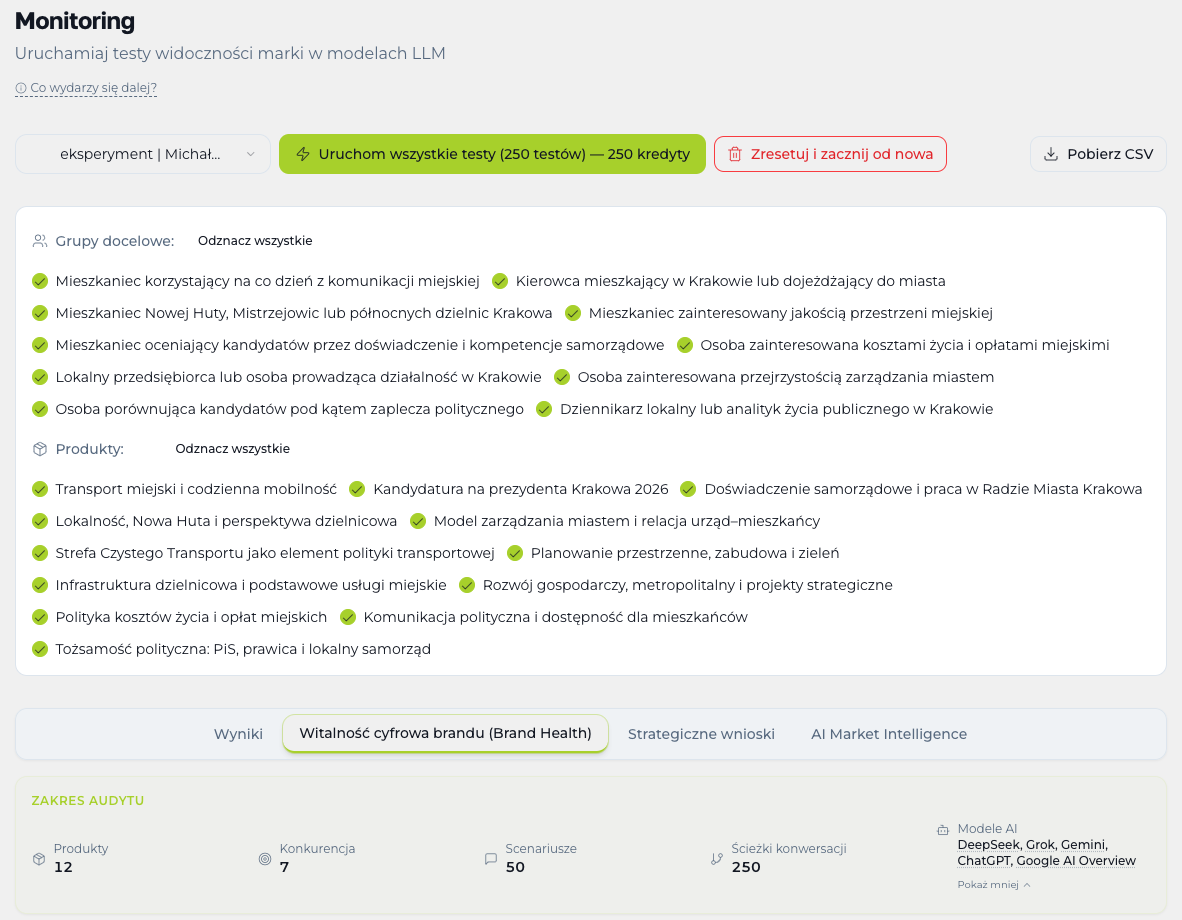
Using our proprietary tool Semantio, I analysed 250 responses concerning Michał Drewnicki in the context of the presidential elections in Kraków. The material is the result of an analysis covering 50 unique scenarios, launched in five systems: ChatGPT, Gemini, Grok, DeepSeek, and Google Overview. Each system responded to the 50 scenarios posed. The scenarios were divided according to the stage of the intention funnel: 80 responses at the awareness stage, 85 at the consideration stage, and 85 at the decision stage. Questions containing the candidate's name and problem questions without the name were analysed separately.
The strongest result concerns the difference between recognition by name and spontaneous visibility. In the entire material, there were 170 responses to questions containing Michał Drewnicki's name and 80 responses to questions without the name. When the user provided the candidate's name (the prompt scenario included the name “Drewnicki”), the models mentioned Drewnicki in 149 out of 170 responses, or 87.6% of cases. When the question did not include the name and concerned an issue, category of candidates, or urban topic, Drewnicki appeared in only 4 out of 80 responses, or 5.0% of cases.
To put it plainly: models can describe the candidate when the user already knows who they are asking about, but they connect him much less effectively to the city's problems on their own.
The data also shows that visibility is not evenly distributed among systems. All 4 spontaneous mentions of Drewnicki in questions without a name came from Google Overview. In the other systems (ChatGPT, Gemini, Grok, and DeepSeek), the candidate did not appear even once in such questions. This is important because it highlights “in numbers” that there is no single, universal “visibility in AI”. Each system can build a different map of the political scene, depending on sources, data freshness, search mechanics, and response generation methods.

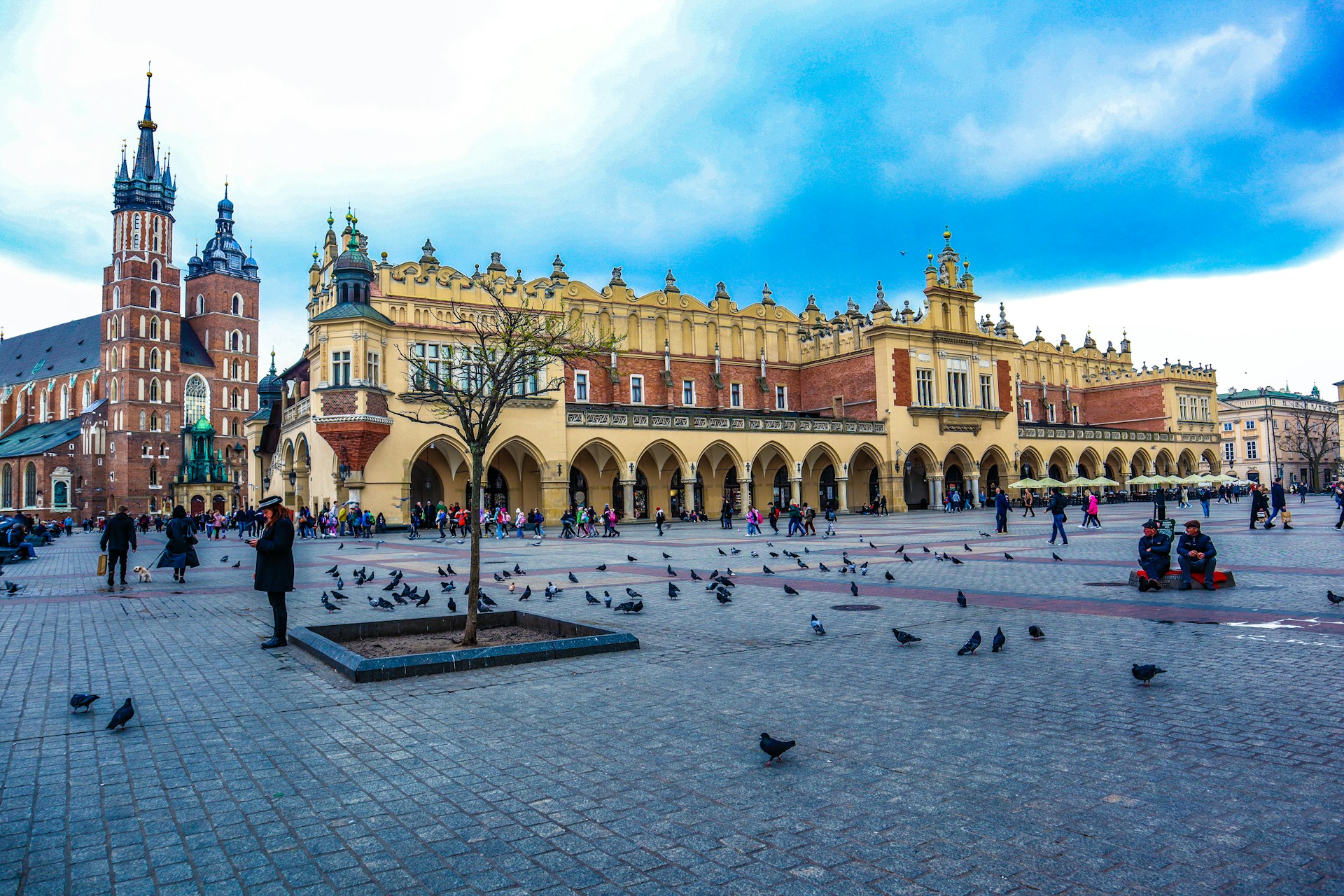
Indeed, I couldn’t resist including this photo in the context of SCT ;)
The clearest hint of thematic visibility appeared in questions about transport, public transport, tickets, mobility, and the Clean Transport Zone. In questions without a name concerning this area, Drewnicki appeared in 4 out of 30 responses, or 13.3% of cases. This is still a low result, but significant compared to other topics: questions about local government experience, Nowa Huta, districts, spatial planning, or green spaces did not trigger his name as effectively. From the perspective of a local campaign, this is an important difference: the model may describe the problem of Kraków well, but it may not necessarily show the voter which candidate is trying to politically address that problem.
In 70 out of 250 responses, or 28.0% of the entire dataset, a hallucination alert was marked. The risk of error did not disappear after providing the name: in questions with the name, the alert appeared in 50 out of 170 responses (29.4%), and in questions without a name in 20 out of 80 responses (25.0%). Most often, these were contextual problems, such as mixing the 2026 elections with the 2024 elections, incorrect public roles, incorrect political affiliation, incorrect or suspicious URLs, unverified programme details, and even confusing Kraków with Warsaw (that’s unforgivable in the City of Krak!). In a local campaign, such minor errors may be more likely than spectacular “fakes”, and thus much harder to catch, as they often occur in responses that sound calm and reasoned. Where have we seen this before?…
Differences between providers (another beautiful word from over the Bug) were evident. Google Overview most frequently mentioned Drewnicki and had the lowest rate of hallucination alerts: 37 mentions in 50 responses (74.0%) and 5 alerts (10.0%). DeepSeek mentioned the candidate in 33 out of 50 responses (66.0%), but simultaneously had the highest share of alerts: 31 out of 50 responses (62.0%). ChatGPT mentioned Drewnicki in 30 out of 50 responses (60.0%) and had 8 alerts (16.0%). Grok mentioned him in 27 out of 50 responses (54.0%) and had 16 alerts (32.0%). Gemini mentioned the candidate in 26 out of 50 responses (52.0%) and had 10 alerts (20.0%). This shows that greater visibility in AI does not always mean higher quality representation.
Sources also arranged interestingly. In the entire dataset, 676 source links were identified. The most frequently appearing domains were: bip.krakow.pl (90 times), facebook.com (71 times), krakow.pl (38 times), youtube.com (29 times), radiokrakow.pl (26 times), lovekrakow.pl (23 times), drewnicki.pl (22 times) and ztp.krakow.pl (22 times). The candidate's official domain was therefore present, but it was far from dominating. The image of Drewnicki in AI was also constructed by BIP, local media, city sources, Facebook, YouTube, and other intermediary domains.
At the same time, in 115 out of 250 responses, there was no source link at all, which constitutes 46.0% of the entire material. Differences between systems were significant: Google Overview provided links in every response, ChatGPT in 43 out of 50, DeepSeek in 31 out of 50, Grok in 10 out of 50, and Gemini only in 1 out of 50 responses. This has electoral significance – a response without a source may sound credible, but the user has no quick way to verify where the model obtained information about the candidate, their role, programme, or the context of the elections.
In LLM responses, competition was also not understood solely as a list of formal electoral rivals. In the competitive field, the most frequently mentioned were Aleksander Miszalski (53 times) and Łukasz Gibała (50 times), but also visible were Andrzej Kulig (14), Konrad Berkowicz (13), Jacek Majchrowski (12), Monika Piątkowska (12), Marian Banaś (12), Daria Gosek-Popiołek (11), Aleksandra Owca (9) and Bartosz Bocheńczak (8). Media, institutions, parties, and organisations also appeared, including Gazeta Krakowska, Dziennik Polski, LoveKraków, Radio Kraków, Koalicja Obywatelska, Lewica, and PiS. For the model, the electoral scene mixes with the informational scene. What does this mean? The candidate competes not only with other names but also with previous contexts, stronger sources, and more entrenched associations.
The shortest conclusion from the study is: a name alone is insufficient. In the world of LLMs, a candidate may be recognised (analysed Michał Drewnicki clearly does not belong to this category yet) when the user asks about them directly, while remaining poorly present when it comes to questions that genuinely initiate the voter's decision: about commutes, costs, districts, green spaces, the office, experience, or credibility on specific issues. This is the layer – not just online presence, but presence in responses to user needs – that needs to be parameterised today.
What Exactly Can Be Measured?
In analysing the results obtained in Semantio, I viewed the responses of large language models not as curiosities but as a new layer of public visibility. In the case of a political candidate, one can analyse, among other things:
spontaneous visibility – does the candidate appear when the user does not provide a name;
correct identification – name, role, party, election year, current context;
position in the response – is the candidate first, middle, last, omitted, or described briefly;
thematic associations – under what topics does the model mention them: transport, SCT, districts, cost of living, local government experience, PiS, right-wing, city management;
comparisons – with whom does the model most frequently compare them and by what criteria; who does the candidate beat, and who has them KO (not referring to a committee!)
sources – does the response rely on current, credible, and relevant data;
hallucinations – a fascinating area where one can see things like confusing people, roles, dates, programmes, election cycles, or non-existent declarations;
interpretative frames – is the candidate presented as party-affiliated, local, municipal, ideological, technocratic, protest-oriented, anti-regulatory, urban, right-wing, “pro-driver”, or in some other way.
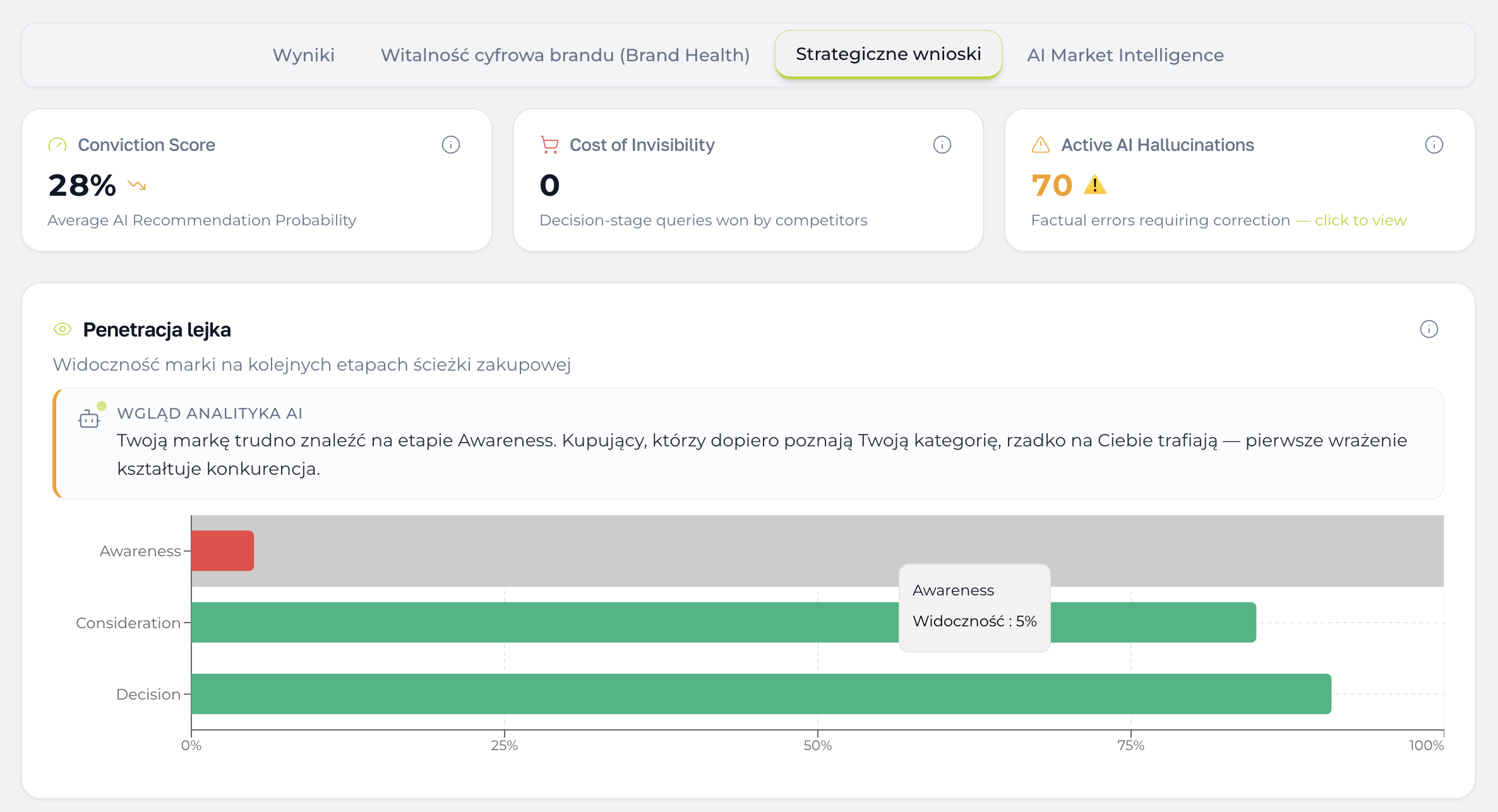
In the case of Drewnicki, three categories for further analysis are particularly evident: recognition by name, thematic visibility, and source quality. The first was high. The second was low. The third proved uneven among providers.
First example: questions about local government experience without providing a name did not spontaneously trigger Drewnicki, even though his institutional profile includes a councillor mandate and a role as vice-chairman of the Kraków City Council.
Second example: questions about Nowa Huta, Mistrzejowice, northern Kraków, and the district perspective also did not suffice for the models to independently indicate the candidate.
Third example: a certain trace of spontaneous visibility appeared mainly around transport and SCT, but it was still very weak compared to responses to questions containing the name.
In short: GenAI can answer the question “Who is Michał Drewnicki?”, but much less frequently responds with his name to the question “Who in Kraków has a stance on my problem?”. This is a difference that is hard to see in classic media monitoring, but which is very significant for a local campaign.
Why This Matters for Campaign Teams, Media, and Civic Organisations
Campaign teams have been monitoring media, social media, polls, and search results for years. The problem is that LLMs do not behave like a regular medium and do not act like a classic search engine. The latter are also increasingly becoming “less classic” before our eyes.
The model does not simply show what is on the internet. The model processes information, summarises it, hierarchises it, sometimes updates it through searching, sometimes relies on knowledge previously established, sometimes refuses to answer, and sometimes responds with great certainty despite incomplete data.
For the campaign team, this means new questions. Is the candidate present in responses to topics that are important to them? Is their profile up to date? Are the models not attributing someone else's declarations to them? Are competitors not taking over topics in AI that are their natural field in the campaign? Will a user asking about “the candidate for transport” even see their name?
Drewnicki's study shows that this question is not theoretical. In questions without a name, the candidate appeared in only 5.0% of responses. For the campaign team, this means the necessity to look not only at whether there are materials about the candidate on the internet, but also at whether the models can connect these materials with the real intentions of voters.
For the media, this means the necessity to view LLMs as intermediaries in the distribution of public information. If models begin to answer electoral questions, the quality of local journalism, the structure of data, the timeliness of sources, and the precision of candidate descriptions will influence not only readers but also the responses synthesised by GenAI.
For civic organisations, this means something else entirely. The ability to examine whether models reliably inform voters, whether they omit candidates, whether they reinforce outdated data, and whether they create informational inequalities between those well-acquainted with the political scene and those who are just trying to orient themselves in it.
Keeping Nerves in Check – For Now, There’s No Indication That GenAI Will Replace Campaigns. But It May Change the Information Map
There’s no point in claiming that the elections in Kraków will be decided in ChatGPT, Gemini, Perplexity, or Copilot. That’s not the case… The campaign is still overwhelmingly taking place “in the city” – at meetings, in local media, at conferences, in debates, in neighbourhoods, in districts, at bus stops, and in conversations among residents.
However, it would be a mistake to consider LLM responses as merely a technological curiosity.
If millions of people are already using ChatGPT in Poland, if about one-third of the population aged 16–74 in the EU is using generative AI, if 13% of eligible voters in the UK used chatbots for electoral information in the week before voting, and experiments show that conversing with a model can shift political opinions – it means that campaign teams and public institutions should start treating AI as a real layer of information circulation. sources: Gemius/PBI, Eurostat, UK study 2024, Cornell Chronicle
In local elections, this layer is particularly important. Why? Because voters often do not seek grand ideology. They seek answers to their own problems. There are many questions: Who understands my district? Who has experience? Who talks about transport? Who has a plan for the cost of living? Who is credible on green issues? Who is actually running, and who was a candidate in previous elections?
How the model answers such questions may not only determine the outcome of entire elections but also the way in which part of the residents understand the candidates.
And this is not visible in polls. It is not visible in classic SEO. It is not visible in media monitoring. But it can be studied.
In the case of Michał Drewnicki, the most important lesson is simple: the candidate may be present in GenAI responses but still lack strong “ownership” (yes, a beautiful Polish word) of the topics that are important to residents. This is the difference – between presence by name and presence in issues – that needs to be treated as a new category of public visibility.
Do you want to check how AI describes your candidate, party, brand, or institution?
Michał Drewnicki's study shows that responses generated by AI models can be systematically analysed in terms of visibility, correctness, sources, comparisons, omissions, and interpretative frames. If you want to learn more about this study or discuss a similar analysis for your own project, contact the author of the text: m.grzebyk@brandsemantics.eu
* Just to clarify – one that appears in the responses ;)