
Search is no longer a directory of links. Today, it is a system that decides on the user’s behalf who to trust, who to cite and who to leave out without a trace. If your brand does not fit into its model of the world, it does not exist – even if you have a strong website, content and SEO. This direction is clearly visible in solutions such as Google’s Search Generative Experience, Perplexity and ChatGPT.
In this environment, a brand is no longer just a domain, a slogan, a set of keywords or a positioning statement described in a strategic deck. For AI systems, a brand becomes an entity: an object with a name, category, offer, audiences, competitors, sources, reputation and a set of claims that can be recognised, omitted, cited, distorted or incorrectly attributed to someone else.
That is why brands need more than classic SEO and more than another batch of texts written “for AI”. They need brand semantics infrastructure – a semantic infrastructure that organises what the brand is, what can be said about it, which sources support its credibility and how AI systems actually present it in answers.
The goal is not to manipulate language models. The goal is to build an information ecosystem around the brand that enables search systems, language models and generative tools to recognise, verify, cite and present it correctly in the right context.
To understand how this process works in practice, see also our article on AI search visibility and GEO.
What is brand semantics infrastructure?
Brand semantics infrastructure is an organised knowledge layer around a brand that helps AI systems understand what the brand is, who it is relevant to, what problems it solves, which categories it should be associated with and which claims about it are supported by sources.
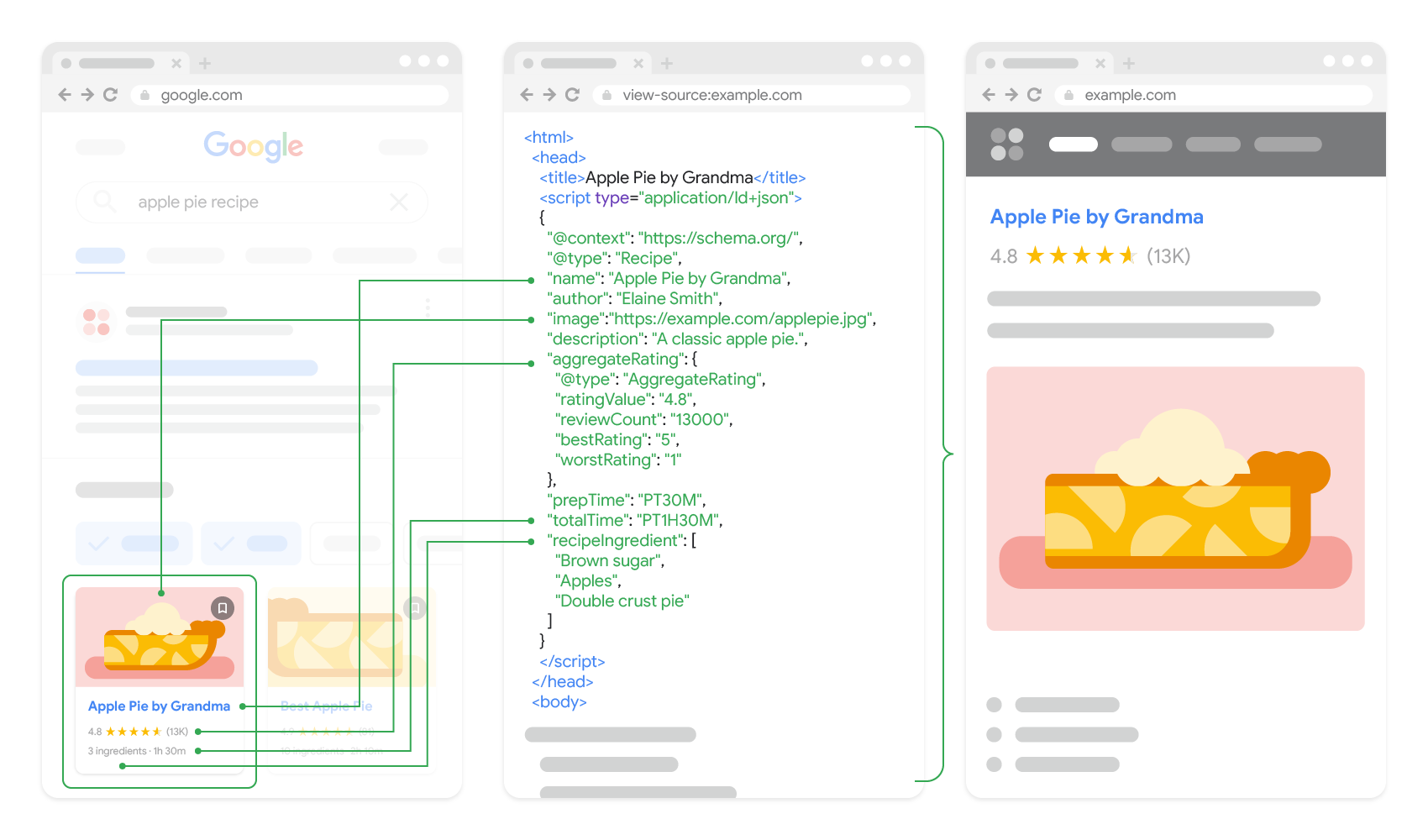
This is not only about “brand semantics” in the narrow sense. It is about a practical system that connects brand strategy, SEO, GEO, information architecture, structured data such as Schema.org, expert content, external sources and AI answer monitoring.
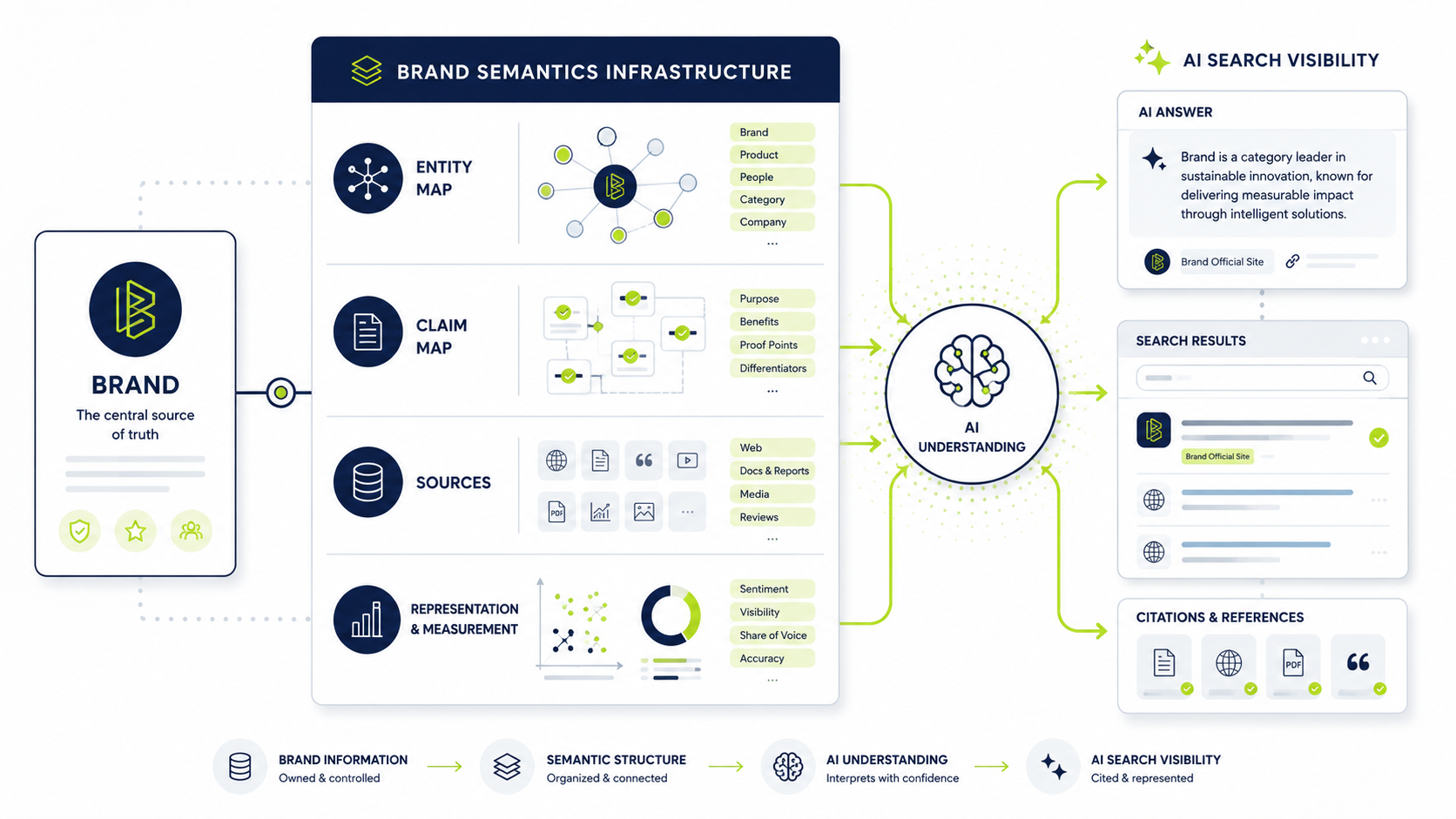
A strong brand semantics infrastructure consists of four core layers.
The first is the entity map. It defines which objects form the brand’s semantic world: the brand itself, variants of its name, products, services, categories, people, locations, audiences, problems, competitors and proof sources.
The second is the claim map. It shows which statements about the brand should be true, up to date, repeatable and possible to verify in sources.
The third is the source layer. It includes the website, blog, landing pages, reports, case studies, company profiles, media, directories, reviews, expert mentions, partner pages and other places from which AI systems may synthesise the brand’s image.
The fourth is the measurement layer. It answers the question of whether ChatGPT, Perplexity, Gemini (Google Gemini) or other systems actually describe the brand in line with its strategy, offer and evidence.
Without these layers, a brand may be present online and still remain poorly legible to AI Search.
Why AI Search changes how brands are understood
In classic SEO, the basic question was: does the page have the potential to be visible in search?
In AI Search, a second, much more complex question appears: how will the answer system present the brand based on the available sources?
This is a fundamental shift. A brand may have a website, content, strong organic rankings and active communication, and still be poorly represented in generative answers. An AI system may omit it from a recommendation, assign it to a category that is too broad, describe it in the language of its competitors, cite an outdated source or reduce a specialised offer to a generic phrase.
Visibility in AI is not only about traffic and rankings. You also need to measure the brand’s presence in answers, how it is described, which sources the system cites, how it is positioned against competitors, how stable the answers are and whether the claims are accurate.
Brand positioning vs brand representation
It is important to distinguish between two concepts: brand positioning and brand representation.
Brand positioning describes how a company wants to be perceived. It is the language of strategy, communication, campaigns, the “About us” page, sales decks and marketing materials.
Brand representation describes how the brand is actually presented by AI systems after they synthesise the available sources.
These two images may be very far apart.
A company may communicate that it is a specialised partner in AI search visibility, GEO and semantic brand analytics. An AI system may still describe it as a “content marketing agency”, an “SEO company” or a “digital marketing consultancy” if that image emerges from its website, older publications, external profiles, reviews, articles or the language used by competitors.
This does not have to be an error made by a single model. It is often a symptom of weak semantic infrastructure.
If a brand does not organise its own entities, categories, claims and sources, AI systems fill in the gaps by analogy – similarly to the way this is discussed in the context of knowledge graphs.
That is why the goal of brand semantics infrastructure is not to create a nicer company description. The goal is to reduce the gap between how the brand wants to be positioned and how it is represented in AI answers.
The brand entity map: what AI should recognise
The first element of semantic brand infrastructure is the brand entity map. Its role is to organise the objects that define the brand and its place in the market.
For AI systems, a brand is not an abstract “love brand”. It is a set of recognisable and interconnected elements. If these elements are unclear, scattered or contradictory, the model may not know which category the company belongs to and when it should be recommended.
An entity map should include at least the following elements:
Entity map element | Control question | Example |
|---|---|---|
Brand name | Does the system recognise name variants as the same entity? | Brand Semantics, brandsemantics.eu |
Category | Which category does AI assign the brand to? | GEO agency, AI search visibility consultancy, semantic brand analytics |
Products and services | Is the offer named clearly? | LLM visibility audit, Semantic Health, SEO/GEO Visibility |
Audiences | Who is the brand relevant to? | CMO, Head of SEO, founder, content strategist |
Problems | What problems does the brand solve? | low AI visibility, semantic drift, incorrect brand representation |
Competitors and alternatives | Who does AI compare the brand with? | SEO agencies, GEO tools, AI visibility platforms |
Evidence | What confirms the brand’s competence? | case studies, reports, methodology, audit results |
Sources | Where can AI find confirmation of the information? | website, blog, media, directories, profiles, documentation |
This is not just a strategic tool. It is the foundation for information architecture, internal linking – for example between services and case studies – structured data and later AI visibility audits.
The claim map: what AI should be able to say about the brand
An entity map alone is not enough. An AI system may know that a brand exists and still not know what exactly can be said about it.
This is where the claim map comes in.
A claim map defines which statements about the brand should be true, up to date, repeatable and supported by sources. In other words: what AI should be able to say about the brand safely.
An example claim map may look like this:
Claim type | Example claim | Required evidence | Risk if evidence is missing |
Category | Brand Semantics specialises in AI search visibility and semantic brand analytics | service page, methodological article | AI describes the brand as a standard SEO agency |
Offer | The company audits how brands are represented in LLMs and AI Search | service landing page, process description, case study | AI does not understand the specific service |
Methodology | The work includes entity mapping, intent scenarios, source analysis and claim accuracy assessment | report, method description, audit example | AI reduces the service to “prompt testing” |
Evidence | The analysis is based on repeatable tests, answer logs and error classification | documentation, reports, research results | AI may not distinguish the service from general consulting |
Limitation | AI visibility cannot be guaranteed by Schema or an llms.txt file alone | educational article, Google sources, technical analysis | the market associates the brand with simplified or risky promises |
AI systems do not cite strategy. They synthesise sentences.
How generic brand language leads to misclassification
One of the biggest problems in AI visibility is imprecise brand language. Companies often describe themselves in a way that sounds broad, modern and safe.
A description such as:
“We help companies grow through innovative digital strategies.”
may be understandable to a human, but it is not very useful for a language model. The system may assign such a company to many categories at once.
A much better semantic description would be more specific – in line with principles discussed, for example, in the Google Helpful Content System.
Your website is no longer the whole brand
Your own domain remains the centre of semantic infrastructure. But AI Search does not build the brand image only from the website.
AI systems may use many sources: media articles, company profiles such as LinkedIn, directories, reviews, rankings, comparisons, forums, partner pages and documentation.
That is why semantic infrastructure must include not only owned content, but also external sources.
What semantic brand infrastructure should include
A strong semantic brand infrastructure is not a single document or a single landing page. It is a system of several layers that together make the brand more understandable to AI.
Layer | What it organises | Typical risk | How to measure it |
Technical access | accessibility, indexing, rendering | lack of crawlability | Google Search Console |
Entity layer | the brand, services, categories | lack of clarity | entity clarity |
Claim layer | claims | lack of evidence | claim accuracy |
Source layer | sources | weak citations | citation share |
Representation layer | how the brand is described | incorrect representation | answer testing |
How to audit brand semantics infrastructure
A brand semantics infrastructure audit should not start with a list of keywords.
A better question is: do AI systems have sufficiently clear material to represent the brand correctly?
The audit process can be extended with prompt and answer analysis – similar to the approach described in OpenAI Evals.
The Brand Semantics Infrastructure Framework
Brand semantics infrastructure can be reduced to five operational steps.
Step | Question | Output | Metric or evidence |
1. Entity mapping | Which objects define the brand? | brand entity map | entity clarity |
2. Claim mapping | What should AI be able to say about the brand? | claim map | claim accuracy |
3. Source alignment | Where are these claims confirmed? | source inventory | source quality |
4. Representation testing | How does AI actually describe the brand? | answer logs | answer quality |
5. Semantic correction | What needs to be improved? | backlog | improved representation |
This framework organises brand work in an AI Search environment.
If you want to implement this approach in practice, see our AI Strategic Consulting.
Brand semantics infrastructure is not an additional layer of communication. It is a condition for credible brand visibility in AI Search.