Brands can optimise their information assets and access conditions. They can only influence retrieval, citation, absorption and recommendation. The GEO control surface provides a practical model for distinguishing controlled interventions from observed outcomes.
The GEO market often labels every desirable outcome as “optimisation”: source selection, citation, brand inclusion, favourable framing and even recommendation. This is a category error.
A brand can change its website, access conditions, information architecture, content, claims and some of the data submitted to external platforms. It cannot instruct a retrieval system to select a particular document. It cannot force a citation or determine how a model will synthesise its sources. Nor does it control the final recommendation.
A mature approach to Generative Engine Optimisation (GEO) therefore requires three distinct modes of action:
directly optimising controlled assets and conditions;
indirectly influencing how information is selected and used;
monitoring outcomes that remain outside the brand’s control.
Put more simply:
GEO is not the optimisation of a model’s answer. It is the optimisation of controlled conditions, an attempt to influence intermediate processes and the measurement of a representation the brand does not control.
“After SEO” does not mean “without SEO”
The word “after” does not suggest that GEO replaces SEO. It refers to the later stages of the information flow – the point at which an available document may be retrieved, selected, used and transformed into an answer.
For Google Search’s generative features, the fundamental requirements of SEO remain an entry condition. Google states that AI Overviews and AI Mode use its core Search quality and ranking systems, Retrieval-Augmented Generation and query fan-out. A page must be indexed and eligible to appear with a snippet, but meeting these conditions does not guarantee crawling, indexing or presentation.
Not every system reaches information through the same route.
OpenAI distinguishes the automated OAI-SearchBot from ChatGPT-User, which may visit a page as a result of a user action. Anthropic assigns separate roles to Claude-SearchBot and Claude-User. Perplexity similarly distinguishes PerplexityBot from Perplexity-User, with user-initiated retrieval potentially operating under different rules from automated indexing.
What should GEO mean?
The original study, “GEO: Generative Engine Optimization”, defined GEO as a black-box optimisation framework designed to increase content visibility within generative-engine responses. The researchers modified documents and measured changes in their exposure. The reported result of “up to 40%” applied to a specific benchmark, its own visibility metrics and a controlled research environment – it is not a benchmark for current production systems.
From Google’s perspective, Answer Engine Optimisation (AEO) and GEO are industry terms relating to visibility in AI search experiences, but optimisation for AI Overviews and AI Mode remains part of Google Search optimisation. Google does not require llms.txt, specialist markup, artificial chunking or a separate writing style for AI systems.
Both definitions are useful, but neither provides a sufficiently neutral definition of the discipline.
An operational definition
Generative Engine Optimisation is the evidence-led practice of modifying controllable information assets and access conditions to create better conditions for generative search systems to find, select, use and accurately represent information – while measuring outcomes that remain outside the brand’s direct control.
This definition does not include:
directly controlling the answer;
training or fine-tuning a provider’s model;
every SEO or PR activity;
monitoring alone;
guaranteeing a mention, citation or recommendation.
The GEO control surface
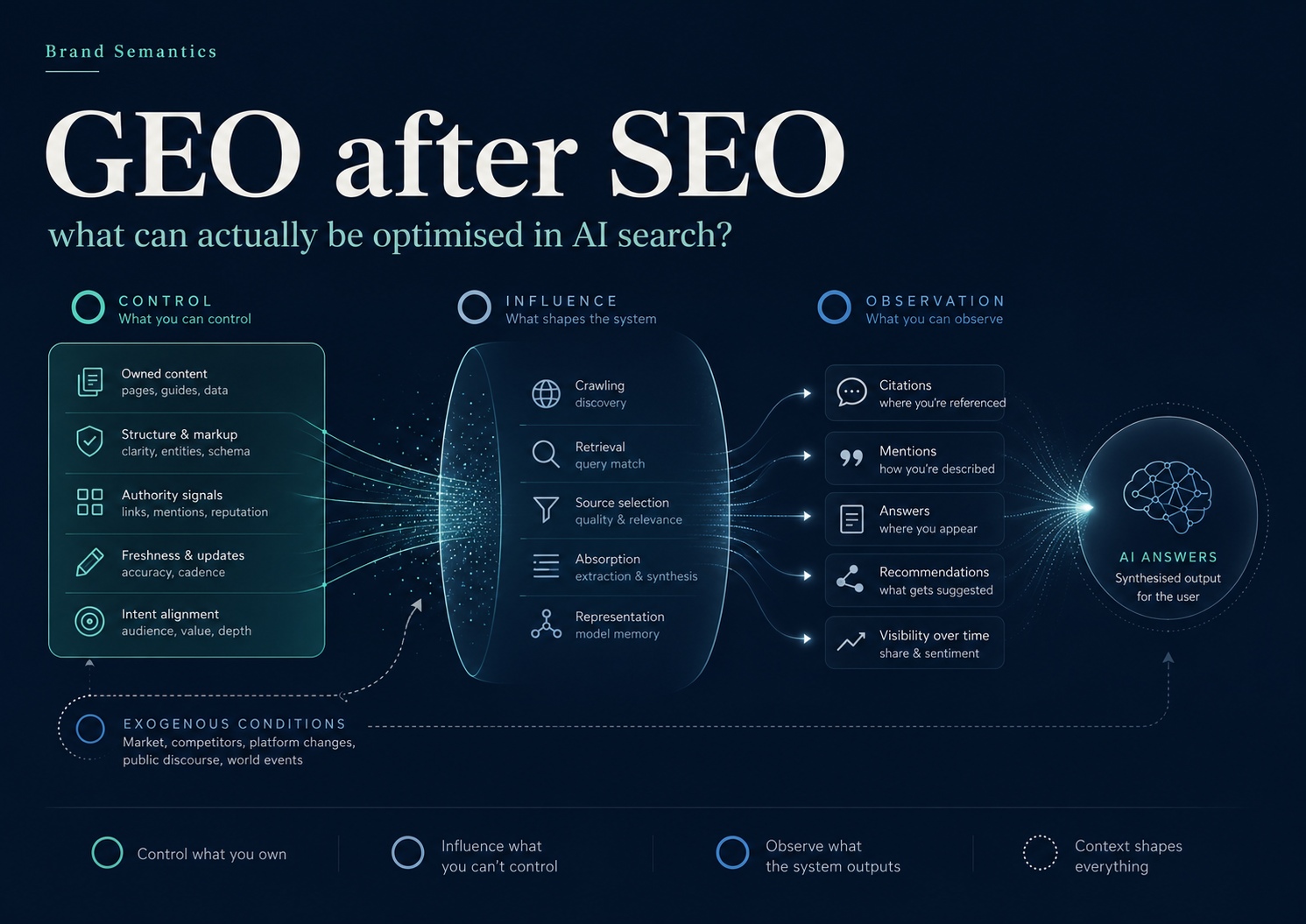
The GEO control surface, proposed by Brand Semantics, organises activities according to the level of agency available to the brand.
Class | Diagnostic question | Appropriate verbs |
|---|---|---|
Control | Can the brand implement and verify the change directly? | optimise, implement, correct, structure, validate |
Influence | Can the brand improve the conditions without controlling the decision? | influence, support, strengthen, manage |
Observation | Is the element primarily an outcome that must be measured? | measure, monitor, detect, compare, estimate |
Exogenous conditions | Can the variable change without any action by the brand? | document, segment, control for, annotate |
The model does not suggest that every element belongs exclusively to one category. Citation, for example, is a process that a brand may attempt to influence and an outcome that it must observe.
The classification describes the appropriate mode of management, not merely the element’s position within a pipeline.
What brands can optimise directly
Direct optimisation is possible where a brand controls the object of the intervention and can verify that the change has been implemented.
Object | What the brand controls | What it does not control |
Technical access |
| Whether the platform retrieves and selects the resource |
Information architecture | Page structure, internal linking, information hierarchy | How the system interprets every relationship |
Content | Definitions, data, evidence, examples and limitations | Whether the document is used |
Claims | Wording, recency, sourcing and consistency | Whether the claim is absorbed accurately |
Structured data | Types, properties and consistency with visible content | Rich results, source selection or citation |
Owned domain and documentation | Publication, updates and availability | Whether the platform prefers another source |
Data submitted to platform profiles | The information supplied by the brand | Moderation, presentation and subsequent use |
Technical access is controllable; inclusion is not
In Google Search, a brand can control whether its pages are technically available for crawling, indexing and snippet presentation. It cannot guarantee that Google will index a page or display it within a generative feature.
The same distinction applies to other platforms:
OAI-SearchBot supports the inclusion of pages in ChatGPT Search features, while GPTBot relates to content that may be used in model development. The controls are independent.
Claude-SearchBot supports indexing intended to improve the quality, relevance and accuracy of Claude’s search results, while Claude-User handles retrieval initiated by users.
PerplexityBot supports Search surfaces, while Perplexity-User may visit a page in response to a user request. Perplexity states that the latter generally ignores
robots.txtbecause the retrieval is user-initiated.
There is therefore no single “allow AI” or “block AI” decision. Automated indexing, retrieval on demand, model development and Web Application Firewall rules must be considered separately.
Content, claims and structured data
A brand can improve:
the precision of its definitions;
the transparency of its methodology;
the quality of its data;
the clarity of its sources;
the structure of its argument;
the recency of its information;
the distinction between facts, interpretations and limitations;
the consistency of names, products and categories.
This does not imply the existence of a universal writing style that guarantees citation.
Google recommends useful, distinctive and non-commoditised content, but rejects the need for a specialist writing style for generative Search, an ideal document length or the artificial division of content into short fragments.
Structured data is also a controllable element. It can help Google Search understand visible content and determine eligibility for particular rich results, but technically correct implementation does not guarantee that those results will be shown. Structured data must reflect information that is available to the user.
The detailed design of entity, claim and source maps is covered in Brand Semantics Infrastructure: how to make AI Search understand your brand correctly. Here, these elements matter as controllable inputs – not as a guarantee of the final representation.
What can only be influenced
A brand can create better conditions for retrieval, source selection and accurate synthesis, but it does not control those decisions.
Retrieval and source selection
Potential interventions include:
technical accessibility;
semantic alignment between the document and the query;
clear terminology;
the presence of relevant claims;
current data;
availability in the user’s language;
external sources that corroborate important information.
However, the full candidate set, all auxiliary queries and the weights applied by the platform remain unknown. Retrieval and source selection are therefore areas of influence and partially unobservable processes.
The absence of a visible citation does not establish that a source played no role in retrieval or generation. Without access to the platform’s internal logs, part of the process remains unobservable. A specific invisible source should not be credited with shaping an answer without additional evidence.
Citation and absorption are not the same
A brand can improve a document, but it cannot implement a citation rate on the page.
Citation rate is an outcome, not an object of optimisation.
The study “From Citation Selection to Citation Absorption” distinguishes between:
citation selection – the selection and presentation of a source;
citation absorption – the influence of the cited page on the language, facts, evidence or structure of the answer.
Within the dataset analysed, citation breadth and depth of influence were not equivalent. The study also found that pages with greater observed influence were more likely to be well structured, semantically aligned and rich in extractable evidence. These are descriptive relationships, not proof that a single structural change will cause higher absorption. The publication is a preprint.
A full methodology for distinguishing citation from absorption requires a separate analysis. For the purposes of this model, the relevant distinction is:
structure and evidence are controllable inputs;
citation selection and absorption are areas of influence;
citation rate and claim absorption are observed outcomes.
External sources
Digital PR, publisher relationships and the correction of external sources may support GEO, but not every mention is a GEO intervention.
An external publication becomes part of a GEO programme when it:
supports a defined claim or entity relationship;
addresses a specific source gap;
is connected to an explicit influence hypothesis;
is subsequently monitored for selection, citation or representation.
The brand controls its own data, research and outreach. It does not control the publisher’s editorial decision or the system’s subsequent selection of the publication.
Framing and recommendation
A brand can:
define its category clearly;
explain relevant use cases and limitations;
publish comparisons based on explicit criteria;
correct inaccurate information;
build consistency between its offer, audience and the problem it solves.
It cannot determine whether a system presents it as the first recommendation, one option among several, a niche solution or a brand that is irrelevant to the scenario.
Recommendation rate, answer salience and framing are observed outcomes. Claiming that a brand can “optimise recommendations” assigns it a level of control that it does not possess.
What should primarily be monitored
AI visibility is not a single metric.
Outcome | Question |
Mention rate | Does the brand appear in the answer? |
Answer salience | What role and position does it receive? |
Citation rate | Is the source visible to the user? |
Citation share | What share belongs to owned, earned and competitor sources? |
Claim absorption | Which claims were used? |
Claim accuracy | Is the information correct? |
Recommendation rate | Is the brand recommended in the appropriate scenarios? |
Competitor co-occurrence | Which alternatives appear alongside it, and according to which criteria? |
Stability | How much does the outcome change between repeated tests? |
Hallucination rate | How often do false or unsupported claims appear? |
A single prompt does not provide a stable measurement of a platform. Answers may vary between runs, prompt variants and dates. Recent preprints recommend treating visibility as a distribution of outcomes and reporting uncertainty rather than presenting individual results with false precision. See “Don’t Measure Once: Measuring Visibility in AI Search (GEO)” and “Quantifying Uncertainty in AI Visibility”.
This article does not resolve the full problem of experimental GEO measurement. That requires a separate methodology covering scenario libraries, repeated trials, platform-change controls, response classification and statistical uncertainty. It will be developed in a separate article.
The C–I–O–X framework
Before selecting a GEO tactic, work through five steps.
1. Identify the object
Do not say “improve AI visibility”. Specify the intervention or measurement:
allow OAI-SearchBot;
update a claim;
publish a methodology;
measure citation rate;
classify framing.
2. Assign a class
C – Control: the brand can implement the change;
I – Influence: the brand can improve the conditions;
O – Observation: the element is an outcome;
X – Exogenous condition: the variable originates in the surrounding system.
3. State the mechanism
Not:
Adding a table will increase citations.
Instead:
A table may make data easier to interpret and comparisons easier to extract, which justifies testing its effect on selection, citation or absorption.
4. Define the evidence level
Does the recommendation come from:
provider documentation;
research;
correlation;
interpretation;
hypothesis?
5. Match the metric and report the limitations
The intervention should be evaluated against an outcome that corresponds to its proposed mechanism, while accounting for variability and alternative explanations.
The most practical principle of GEO is therefore:
Optimise the assets and conditions you control. Influence the source environment where possible. Measure the representation you do not control.
If a team cannot distinguish between these three layers, its next step should not be another GEO tactic. It should be a diagnosis of its GEO control surface.
Sources and methodological notes
Official provider documentation
Google Search Central, “General structured data guidelines”, updated 10 July 2026.
Anthropic Privacy Center, documentation covering ClaudeBot, Claude-SearchBot and Claude-User.
Research
Sielinski, R., “Quantifying Uncertainty in AI Visibility”, arXiv:2603.08924, version 2, 9 June 2026.
Brand Semantics contributions
The operational definition of GEO, The GEO control surface and the C–I–O–X classification are methodological proposals developed by Brand Semantics. They are not official provider terminology or a generally accepted academic standard.