A large language model can readily tell a brand’s story and list its most significant achievements. Yet when someone asks it to make a specific choice, that same brand disappears from the answer. There is a gap between knowing a name and using it—one that is easy to miss if we only ask questions about the brand itself.
In “Polish Generative Portrait”, Grzegorz Miłkowski, the study’s author, illustrates this difference using Poland as an example. The research examines how the country is represented in the responses of six language models. But its findings raise an important question for companies, cities and institutions too: does a model bring us up when we could help someone make a decision?
Two kinds of presence
In the main study, six models—ChatGPT, Gemini, Claude, Perplexity, Grok and DeepSeek—generated 8 400 responses to 1 400 questions in 11 languages, representing 12 markets. Half the questions concerned individual needs; the other half focused on business decisions. Most of the report’s percentage results come from this dataset. Including supplementary measurements, such as a separate test for businesses and topic-specific measurements, the full programme covered more than 14 500 responses. One supplementary measurement examined which people, brands and symbols the models named when asked directly about Poland.
This distinction is fundamental. The question “What is Poland famous for?” measures the availability of associations. “What should I do in Warsaw for three days?” or “Where should I locate a factory?” tests which associations the model can put to use. The report covers responses returned through APIs at a particular point in time. It does not measure people’s opinions or the effectiveness of promotional campaigns.
In the supplementary “Poland on request” measurement, when models were asked to name the most famous Poles, Chopin, Wałęsa, Copernicus and John Paul II appeared in 144 of 144 responses to that question. In a subset of 1 116 practical responses from the main study, selected so that the names could naturally appear, Copernicus featured in 4,5%, Skłodowska-Curie in 0,8%, Lem in 0,2% and Chopin in 12%.
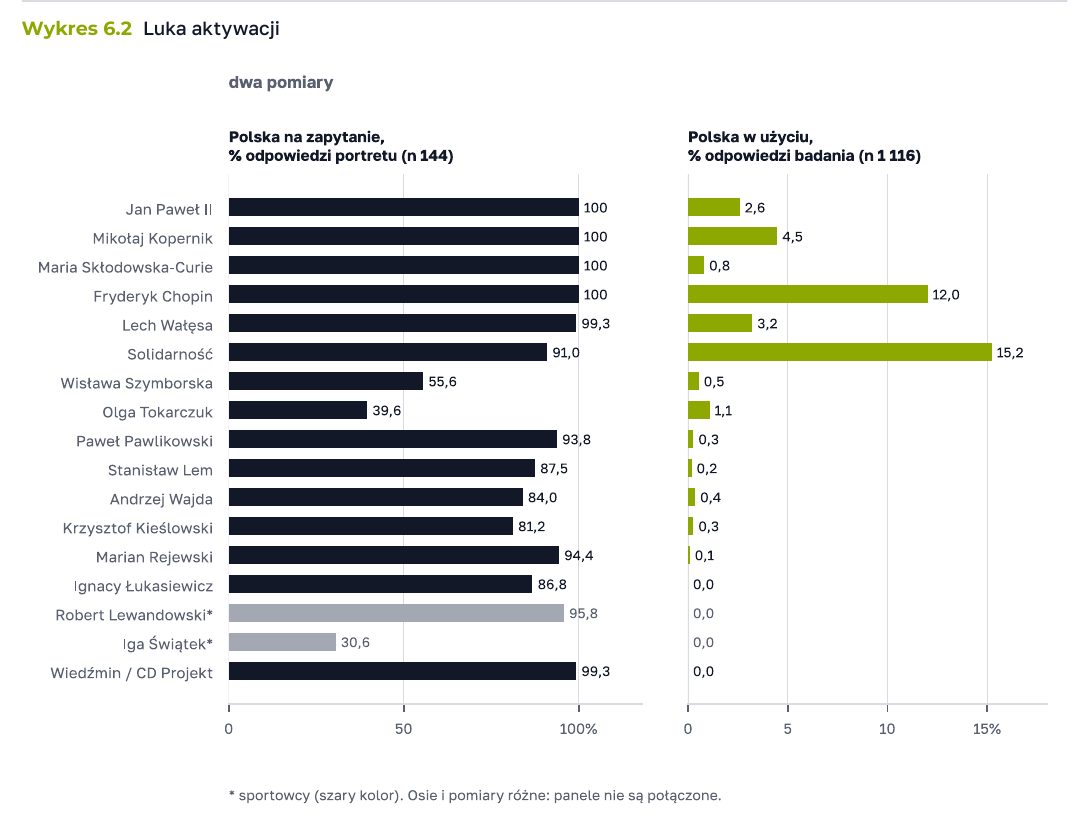
Chart 6.2, “The activation gap”. Source: Grzegorz Miłkowski, “Polish Generative Portrait”, p. 50
These figures should not be subtracted from one another as if they were results from the same test: the questions, dates and denominators differ. The comparison nevertheless reveals a clear qualitative difference. A name that is available when prompted does not necessarily make it into an answer to a practical problem.
The report’s author calls this the activation gap. It is a useful concept for brand strategy because it separates recognition from presence in situations where an audience could genuinely benefit from a product, service or expertise.
Same model, different question
The clearest test of this idea comes from the main study itself. When the six models answered 12 questions asking “What is Poland famous for today?”, Polish video games appeared in 86,1% of 72 responses. They did not appear once in 1 116 practical responses. These subsets serve different purposes, and the practical questions did not include any about games. The result therefore reflects the scope of the situations studied, not every possible way CD Projekt or The Witcher might appear in AI.
This caveat matters beyond research on Poland. If we ask a model “Do you know our company?”, we are primarily testing whether it can describe the business. To understand the likelihood of appearing in customers’ answers, we need to ask about their tasks without naming the brand.
The routes that bring a name into the answer
Why does Chopin appear more often than other figures in the national canon? Among the 134 practical responses that mentioned him, 97% also mentioned Warsaw or Żelazowa Wola. Chopin is linked to concerts in Łazienki, places to visit and specific travel itineraries. Solidarity and Wałęsa enter through Gdańsk and the shipyard; Copernicus through Toruń and Frombork.
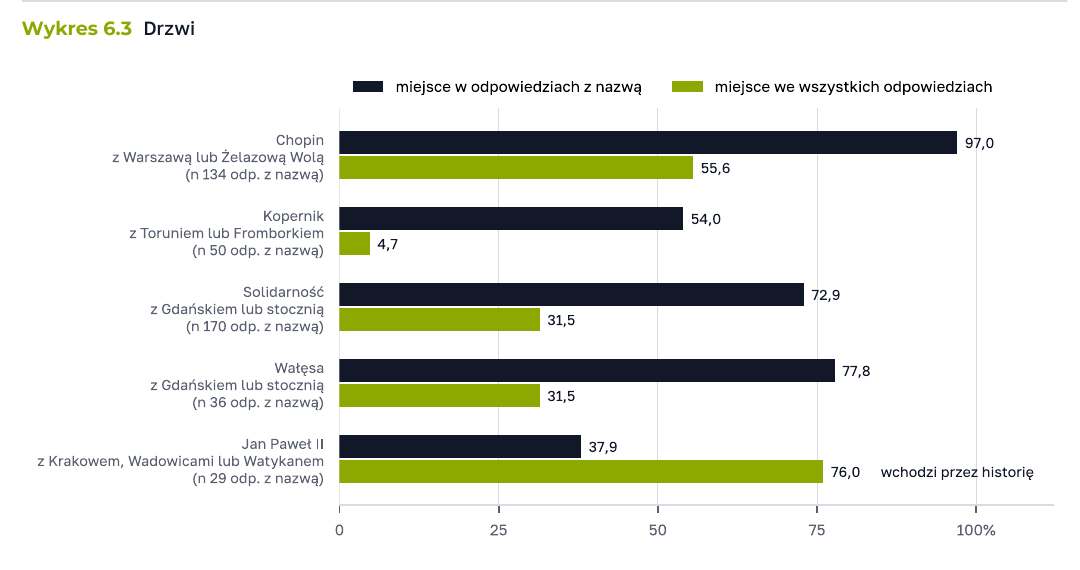
Chart 6.3, “Routes in”. Source: Grzegorz Miłkowski, “Polish Generative Portrait”, p. 51
In brand semantics, these are relationships between entities: recognisable people, organisations, places, products and concepts. The relationship “Chopin – Poland” is broad. The chain “Chopin – Warsaw – Łazienki – concert during a trip” can answer a specific intent.
This does not mean you can add a few names to a website and control the model. Connections must be accurate, clear and present in credible sources. It is still worth understanding which connections are already working—and which are missing from questions that matter to the brand.
Company size is not enough
The same mechanism is visible in the report’s business section. In a separate measurement, when asked directly about Poland’s largest companies, the models named KGHM in 144 of 144 responses to that question, PGE and PKO Bank Polski in 143, and PZU in 139. Across 4 200 practical business responses in the main study, KGHM appeared 21 times, PKO 15 times and PZU once.
Organisations associated with a specific task appeared much more often: Krajowy Rejestr Długów in 143 responses, BIG InfoMonitor in 97, Polskie Sieci Elektroenergetyczne in 95 and No Fluff Jobs in 71. KRD is a useful reference when checking a business partner, PSE for questions about the electricity grid, and No Fluff Jobs for recruitment.
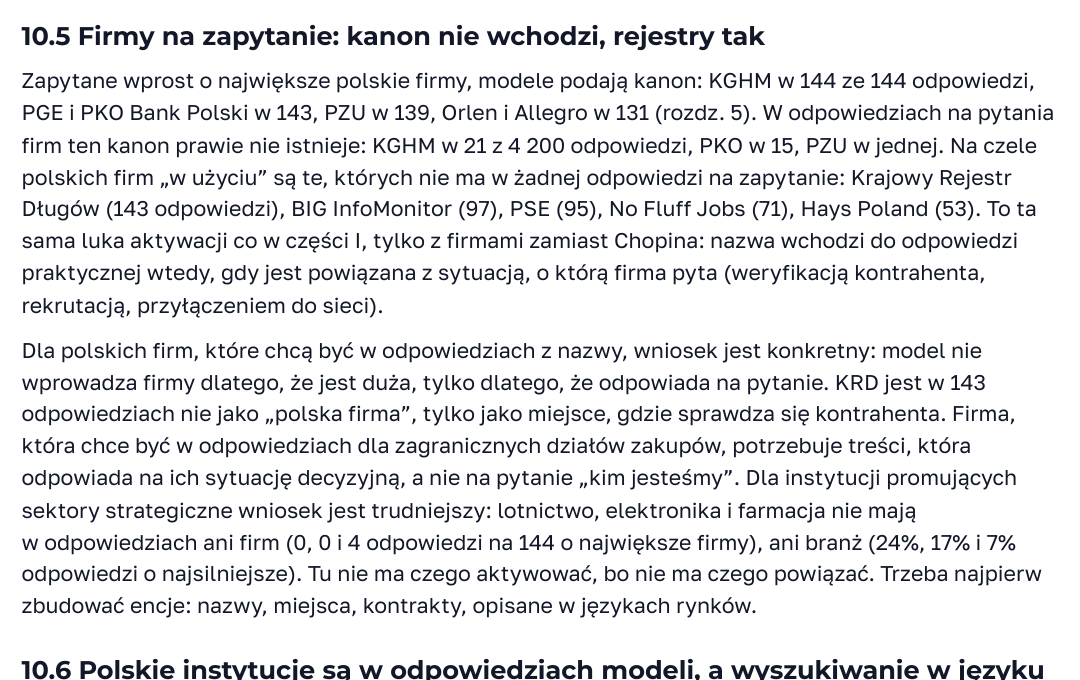
Extract from section 10.5. Source: Grzegorz Miłkowski, “Polish Generative Portrait”, p. 152
This is not a ranking of these organisations’ value. It shows how much depends on the role a name plays in a particular situation. A brand can be enormous yet have no “route in” to the questions covered by the study. A smaller brand may have a function that is easy to bring into an answer.
How to measure your brand’s activation gap
Start with a map of decisions, not a list of general questions about the company. Distinguish between questions that do not name the brand but could prompt a recommendation, and questions that do name it and reveal how the model describes it. This approach is closely aligned with how we explain the difference between SEO work and researching brand representation in AI.
For example, a component manufacturer should test questions about certified suppliers, production capacity, delivery reliability and supply markets. A university could examine questions about studying in a particular language, tuition fees and living costs. A city should look at scenarios involving a weekend break, a family trip or travel to an event.
For each response, record more than whether the brand is mentioned. Is it recommended? What role does it play? Which attributes and competitors appear alongside it? What sources support the answer? Does the model misrepresent the offering or attribute outdated information to the brand? Monitoring model responses is useful when it tracks the same scenarios across successive measurements.
The next step is to consider the material the brand can create. A well-described use case connects the company’s name with a problem, a solution, a place and evidence. For a supplier, that might mean standards, the scope of certification, products, references and limitations. For a tourism organisation, it could mean specific routes, dates, costs and practical information in the audience’s language.
The report also highlights the limits of these recommendations. Polish companies appeared in five of 30 responses to questions about certified subcontractors. The study does not establish whether this was due to a lack of online material. It does, however, identify a decision-making scenario in which it is worth checking the quality of available evidence and measuring the responses again.
Presence is a process, not a state
Model versions and source selection change over time. A single response may be an interesting observation, but it does not describe a brand’s lasting position. We need a dated, repeatable measurement using comparable questions, markets and models, with the responses themselves retained.
“Polish Generative Portrait” shows that recognition is only one dimension of representation. The more important question is: for which decisions does a model consider our name useful, and why?
The full report by Grzegorz Miłkowski, its methodology and source materials are available on the project website. You can also read more about our approach to brand research on the Brand Semantics blog.