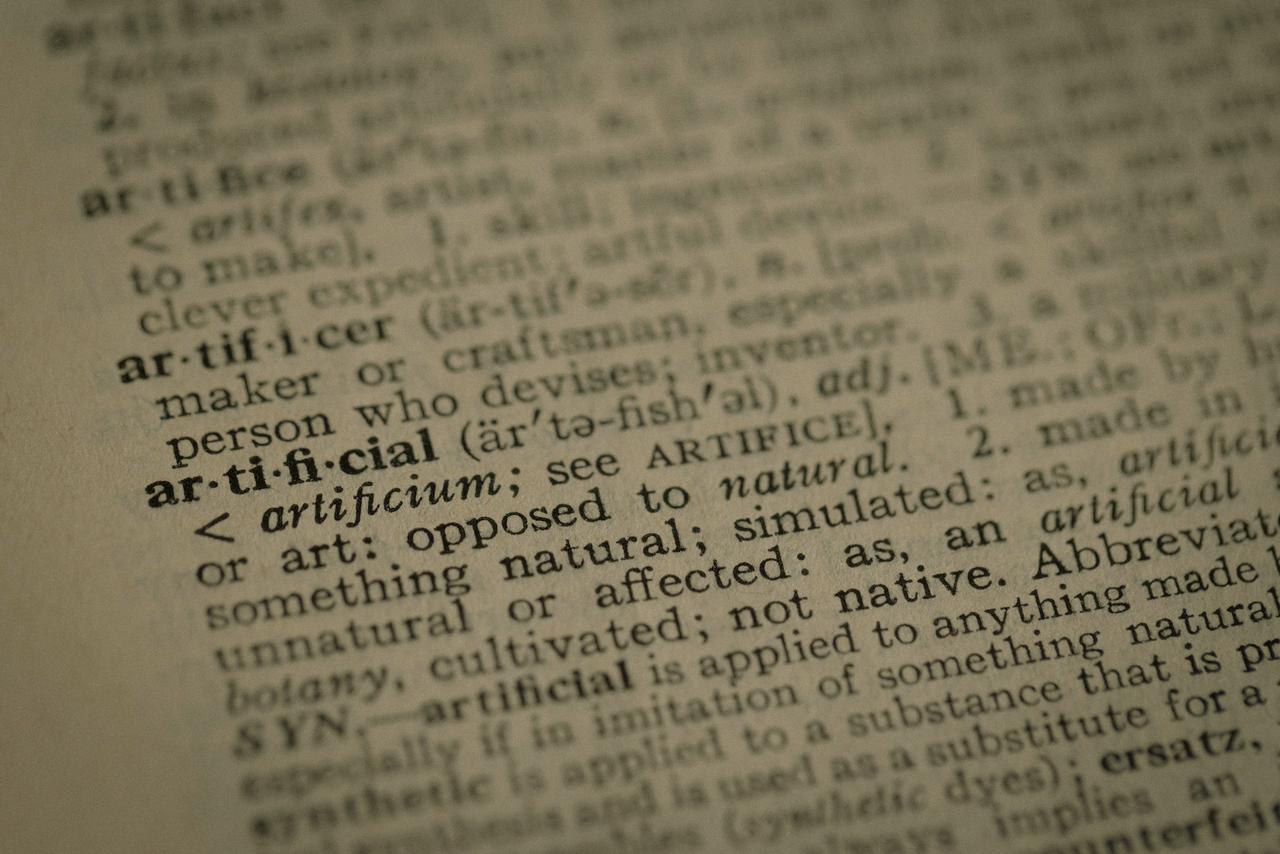
Sebastian Kondracki does not like the name “artificial intelligence”. Donald Trump wanted to replace it too. Kondracki, a co-creator of Bielik, prefers “collaborative intelligence”: a name that puts the relationship with people first. The US president ordered his administration to use “Super Intelligence”. A similar objection to a name produces two rather different stories about a technology. In Polish, there is one more twist. The abbreviation SI can stay exactly the same while its meaning changes. [1, pp. 263–264] [2] [9]
A passage in RzeczpospolitAI, the book by Krzysztof Domaradzki and Artur Kurasiński, made me stop and think. I had never come across Kondracki’s preferred Polish phrase, kolaboratywna inteligencja, before. In their interview, he explains that “artificial” suggests something deficient or inferior to the natural thing. He would rather name a technology that extends human capabilities. Kondracki is associated with the SpeakLeash initiative and the Bielik project. [1, p. 263]
The Polish wording has a complication that a straightforward English rendering can conceal. Kolaboratywna is meant to suggest working together, but kolaboracja can also evoke collaboration in a troubling historical sense. Kondracki acknowledges the problem himself. The intended invitation to cooperate may therefore meet an association that pulls in another direction. All this trouble before we have even reached the noun. [1, p. 263]
Trump took the administrative route. His executive order of 29 September 2026 directs federal executive departments and agencies to use “Super Intelligence” and “SI” instead of “Artificial Intelligence” and “AI” in official correspondence, public communications and other non-statutory documents, to the extent permitted by law. The scope matters: this is not a general prohibition on anyone outside the federal executive branch saying “AI”. [2, Section 2]
That is what interests me about these two cases. A name comes with a suggested interpretation of the technology. What changes in our expectations when we call a system collaborative, general, human-centred or superintelligent? And where does the meaning of the term end and the promise we attach to it begin?
what is artificial about artificial intelligence?
Let us start with the word that set this whole argument in motion. “Artificial intelligence” appears in the proposal for the Dartmouth Summer Research Project dated 31 August 1955. John McCarthy, Marvin Minsky, Nathaniel Rochester and Claude Shannon proposed that aspects of learning and intelligence could be described precisely enough for a machine to simulate them. Their research agenda included language use, concept formation and problems previously reserved for people. [3]
In that context, “artificial” points to certain capabilities being realised by a constructed system. Kondracki hears something else in the word: the suggestion that the artificial is worse than the natural. One adjective, two layers of meaning. They are worth separating. A technical definition does not exhaust what an audience hears. [3] [1, p. 263]
Tiffany Petricini is also interested in what people hear in the language of AI. Her analysis examines how terms associated with assistance and cooperation act as interpretative frames, directing attention towards particular functions and relationships with users. This is a semantic and rhetorical analysis, not an experiment measuring people’s reactions to each name. It does, however, leave us with a useful question: what have we assumed about a system before we have checked what it does? [23]
superintelligence: a capability or a new label?
Superintelligence has a history longer than this dispute over terminology. In “How Long Before Superintelligence?”, written in 1997 and revised the following year, Nick Bostrom defined it as an intellect far exceeding the best human minds in practically every field, including scientific creativity and social skills. That is a high bar. The term described a particular level of capability. [4]
Section 3(a) of Trump’s order does something different. For the purposes of the order, “Super Intelligence” covers technologies and systems included in the existing statutory definition of artificial intelligence. In this document, the name of an existing category changes. That change does not demonstrate that the systems have reached Bostrom’s threshold. A new sign on the door does not upgrade what is behind it. [2, Section 3(a)] [4]
The chronology is worth keeping straight, too. Silicon Valley did not begin talking about superintelligence after the executive order. In “Reflections”, published in January 2025, Sam Altman presented superintelligence as an aim beyond AGI, or artificial general intelligence. In July 2025, Meta published Mark Zuckerberg’s vision of “personal superintelligence”. Neither earlier statement can be described as a response to an order issued in September 2026. [5] [6]
In an NVIDIA announcement dated 8 October 2026, Jensen Huang used “Super Intelligence” while discussing advanced technology for American scientists. Microsoft AI, meanwhile, has developed its own vision of “Humanist Superintelligence”, with systems intended to remain subordinate to and under the control of people. Whenever we encounter one of these declarations, we need to ask what the speaker means: a future destination, a present technology or a principle for designing it? [8] [7]
the Polish SI: same letters, different meanings
Here is a small linguistic detail with a surprisingly large consequence. In Polish, SI already stands for sztuczna inteligencja, the Polish term for artificial intelligence. The Polish-language version of the European Commission’s 2018 communication Artificial Intelligence for Europe uses precisely that abbreviation in its introduction. In the US executive order, by contrast, SI stands for “Super Intelligence”. [9, Section 1] [2]
Typographically, this is convenient. Interpretatively, less so. A Polish reader could see a reference to the “development of SI” without immediately knowing whether the writer means artificial intelligence or superintelligence. This is a possible ambiguity revealed by putting the two expansions side by side. It is not a measured finding about how Polish readers actually respond. [9] [2]
I can see the communicative appeal: the familiar two letters remain while we offer them a new expansion. There is no new abbreviation to learn. The price of that convenience is that the visible signal of a conceptual change disappears. Context must tell the reader whether we are discussing a field of technology or a claimed level of capability.
Kondracki’s preferred name runs into a different linguistic problem. He wants to emphasise cooperation, yet recognises that the Polish associations of kolaboracja may get in the way. It is a useful reminder of what can happen when a name travels between languages. A speaker’s intention and a listener’s associations need not arrive at the same place. [1, p. 263]
human–computer collaboration has a longer history
Let us leave the latest labels aside for a moment. The idea that computers could strengthen human abilities did not begin with today’s chatbots. J.C.R. Licklider described “man-computer symbiosis” in 1960. Two years later, Douglas Engelbart set out a framework for augmenting human intellect through a designed system of tools, language and working methods. [10] [11]
That tradition offers one way to read today’s “augmented intelligence”. The point of reference is what a person can do with the help of technology. Ethan Mollick’s 2024 book Co-Intelligence: Living and Working with AI popularises a related view of working together. Related ideas, though, are not necessarily interchangeable definitions. [11] [14]
The distinction becomes clearer with the more specific definition of “hybrid intelligence” offered by Dominik Dellermann and his co-authors. They describe a configuration of humans and AI that performs better than its participants would separately and improves through mutual learning. Merely putting a person and a model at the same desk does not satisfy that definition. The cooperation has to achieve something more particular. [12, Section 4]
“Collective intelligence” has a different scope again. It concerns groups acting together in ways we recognise as intelligent; research in the field also examines combinations of people and computers. AI may be part of such a group, but the concept does not require it. [13]
a map of AI names and their meanings
It is easy to lose track of these terms, so let us arrange them by what they describe. The map below brings together selected uses in research and public communication. Its final column is my interpretation of what each name draws attention to. It is not a measurement of audience reactions.
name | what it describes in the cited source | what it draws attention to |
|---|---|---|
artificial intelligence | a research programme concerning intellectual capabilities realised by machines [3] | the capabilities of a constructed system |
augmented intelligence | the extension of human capabilities, read in the tradition of Engelbart [11] | what people can do with tools |
collaborative intelligence, as used by Kondracki | cooperation with people and the extension of natural intelligence [1, pp. 263–264] | the relationship between people and technology |
hybrid intelligence | a human–AI configuration with a better joint result and mutual learning [12] | how cooperation is organised and how well it works |
collective intelligence | intelligent group activity, potentially involving computers [13] | the capabilities of the group as a whole |
human-centred AI | design focused on people, their control and responsibility [15] | design and oversight |
generative AI | the generation of content from the structure and properties of underlying data [16] | the kind of output produced |
agentic AI | a way of organising a system’s actions, including its choice of steps and tools [17] | independence in carrying out tasks |
AGI | the breadth of capability considered alongside performance level [18] | range of tasks and level of competence |
superintelligence | in Bostrom’s definition, intellectual capability far beyond humans in practically every field [4] | capability relative to people |
This is not a ladder of successive AI generations. The names describe different dimensions: a model that generates content may be part of an agentic system that helps a person. None of those descriptions establishes, by itself, that AGI has been achieved. Morris and his co-authors therefore propose considering generality, performance and autonomy separately. [16] [17] [18]
what does research tell us about the effect of a name?
Can a name really change how people assess a technology? There is research behind that intuition. Markus Langer and his co-authors ran two studies with 397 and 622 participants respectively. They examined how terms for systems that make or support decisions affected perceptions of their properties and assessments of their use in particular settings. Terminology affected, among other things, perceived complexity and trust. [19]
We should not conclude that adding “AI” always helps. Across six experiments, Mesut Cicek, Dogan Gursoy and Lu Lu found that identifying AI in product and service descriptions reduced purchase intentions. Emotional trust played a part, and the negative effect was stronger when the product was perceived as riskier. The outcome measured here was purchase intention, not a fall in actual sales. Nor does it justify extending the finding to every other use of large language models or AI. [21]
Cindy Candrian and Anne Scherer found a different pattern. Across three studies, people responded more favourably to an error made by a system presented as AI than to an error made by one presented as algorithmic. There is a detail I do not want to lose: participants were also given different descriptions of how the systems worked. The AI system was described as learning, while the algorithmic system was described as rule-based. The studies therefore tested a label together with an explanation of capabilities. We cannot attribute the whole effect to the label alone. [20]
I have put these studies next to one another because they examine different situations: assessing a system, considering a purchase and responding after an error. How we introduce a technology matters. They do not hand us a universally best name. Nor do they directly test the Polish contrast between “artificial” and “collaborative” intelligence. [19] [20] [21]
“collaborative” is a promise to test, too
Let us return to Kondracki. For him, a change of name accompanies a change in the conversation about adoption: away from reducing costs and cutting jobs, towards creating additional business value. “The way people think about this technology really does affect how it is used,” he says in the interview. That is a practitioner’s observation and an argument for a particular approach, translated here from the Polish. [1, p. 264]
Cooperation itself does not guarantee a better outcome in every comparison. Michelle Vaccaro, Abdullah Almaatouq and Thomas W. Malone analysed 106 experimental studies published between January 2020 and June 2023. On average, human–AI combinations performed better than humans working alone, but worse than whichever performed better when humans and AI were assessed separately. [22]
It is easy to overlook the difference between helping a person and achieving synergy. A worker’s result may improve without the combined approach outperforming the AI system on its own. The meta-analysis does not settle the question for every present-day application. It does show why a promise of collaboration needs two further questions: for which task, and compared with what? [22]
There is also a way to defend the human role without the language of partnership. In his account of human-centred AI, Ben Shneiderman proposed combining high levels of automation with high levels of human control. He favoured metaphors of tools that empower people over images of autonomous team members. A related aim; a different choice of words. [15]
what does this mean for the language brands use?
At Brand Semantics, I am particularly interested in the point at which a name begins to stand in for an explanation. If a product is called “superintelligent”, I want to know what it outperforms and by how much. If a system is “collaborative”, how exactly does it divide the work with a person? If it is “human-centred”, where do control and responsibility sit? These names are a place to begin checking the promise.
The same applies to brands. A category name tells us little if we cannot establish which claims about a company are supported by sources. We explore that relationship further in our article on brand semantics infrastructure.
Here is a simple exercise. Take the description of a product, service or implementation and answer three questions: what does the system do? What remains the person’s responsibility? On what basis do we judge the result? A useful name helps organise the answers. If it takes the place of an answer, we need to add the specifics. The adjective cannot do that work for us.
Describing the brand itself before studying AI answers requires similar discipline. We need to separate facts from aspirations and establish which names refer to the same entity.
The Polish SI makes the larger point unusually visible. Two familiar letters can remain on the page while the conversation moves from artificial intelligence to superintelligence. That is why the expansion matters. Readers should be able to tell whether we are naming a field, a way of working together, a company’s ambition or a demonstrated level of capability.
Kondracki’s interview and Trump’s order give me a reason to examine adjectives as carefully as demonstrations of the technology. “Artificial”, “collaborative” and “super” invite different questions. Good communication must go one step further, from the name to answers we can check. [1, pp. 263–264] [2]
I used ChatGPT while working on this piece, particularly the Consensus tool. Dawid, thank you for recommending it!
I might not have followed this line of thought at all without reading successive issues of Artur Kurasiński’s Technofobia newsletter. If you read Polish, I recommend subscribing wholeheartedly. At a time when so much content is fleeting and thin, Artur’s emails deliver something to think about.
sources and precise references
The numbered references in the article link to their sources. Book page numbers, document sections, bibliographic details and DOIs are given where applicable. The map of meanings and interpretative conclusions are my synthesis of these sources. Online sources for the Polish article were accessed on 11 November 2026.
[1] Krzysztof Domaradzki and Artur Kurasiński, RzeczpospolitAI, 2026, interview with Sebastian Kondracki, “Orzeł wzbija się do lotu”, pp. 263–264. Page references checked against photographs of the book; an excerpt was also published by Domaradzki on 26 October 2026. view source
[2] Donald J. Trump, Executive Order 14434, “Inaugurating the Era of Super Intelligence”, 29 September 2026, Sections 1–3, particularly 2(a) and 3(a). view source
[3] John McCarthy, Marvin L. Minsky, Nathaniel Rochester and Claude E. Shannon, “A Proposal for the Dartmouth Summer Research Project on Artificial Intelligence”, 31 August 1955, opening two paragraphs. view source
[4] Nick Bostrom, “How Long Before Superintelligence?”, 1997, revised 25 October 1998, “Definition of ‘superintelligence’”. view source
[5] Sam Altman, “Reflections”, January 2025, paragraphs beginning “We are now confident…” and “We are beginning to turn our aim…”. view source
[6] Meta, “Personal Superintelligence for Everyone”, 30 July 2025, statement presenting Mark Zuckerberg’s vision. view source
[7] Mustafa Suleyman, “Towards Humanist Superintelligence”, Microsoft AI, 2025, particularly “Humans matter more than AI”. view source
[8] NVIDIA, “NVIDIA Commits $1 Billion to Advance US Science Over the Next Five Years”, 8 October 2026, opening paragraph and Jensen Huang’s statement. view source
[9] European Commission, Sztuczna inteligencja dla Europy, the Polish-language version of Artificial Intelligence for Europe, COM(2018) 237 final, 25 April 2018, Section 1. The Polish version is necessary here because it documents the abbreviation SI. view source
[10] J.C.R. Licklider, “Man-Computer Symbiosis”, IRE Transactions on Human Factors in Electronics, HFE-1(1), 1960, pp. 4–11, particularly the introduction. DOI: 10.1109/THFE2.1960.4503259. view source
[11] Douglas C. Engelbart, Augmenting Human Intellect: A Conceptual Framework, SRI, October 1962, Sections I.A “General” and II “Conceptual Framework”. view source
[12] Dominik Dellermann, Philipp Ebel, Matthias Söllner and Jan Marco Leimeister, “Hybrid Intelligence”, Business & Information Systems Engineering 61, 2019, pp. 637–643, particularly Section 4 “Defining Hybrid Intelligence”. DOI: 10.1007/s12599-019-00595-2. view source
[13] MIT Center for Collective Intelligence, Handbook of Collective Intelligence, Main Page, working definition of collective intelligence and the research question concerning combinations of people and computers. view source
[14] Ethan Mollick, Co-Intelligence: Living and Working with AI, Portfolio, 2024; publisher’s description and publication date of 2 April 2024. view source
[15] Ben Shneiderman, “Human-Centered Artificial Intelligence: Three Fresh Ideas”, AIS Transactions on Human-Computer Interaction 12(3), 2020, pp. 109–124. DOI: 10.17705/1thci.00131. view source
[16] NIST Computer Security Resource Center, “generative artificial intelligence”, glossary definition and the source documents listed there. view source
[17] Erik Schluntz and Barry Zhang, “Building Effective Agents”, Anthropic, 19 December 2024, “What are agents?” and the distinction between workflows and agents. view source
[18] Meredith Ringel Morris, Jascha Sohl-Dickstein, Noah Fiedel, Tris Warkentin, Allan Dafoe, Aleksandra Faust, Clement Farabet and Shane Legg, “Position: Levels of AGI for Operationalizing Progress on the Path to AGI”, ICML, PMLR 235, 2024, pp. 36308–36321, abstract and Section 6.2 “Capabilities vs. Autonomy”. view source
[19] Markus Langer, Tim Hunsicker, Tina Feldkamp, Cornelius J. König and Nina Grgić-Hlača, “‘Look! It’s a Computer Program! It’s an Algorithm! It’s AI!’: Does Terminology Affect Human Perceptions and Evaluations of Algorithmic Decision-Making Systems?”, CHI 2022, Studies 1 and 2. DOI: 10.1145/3491102.3517527; linked author version. view source
[20] Cindy Candrian and Anne Scherer, “How Terminology Affects Users’ Responses to System Failures”, Human Factors 66(8), 2024, pp. 2082–2103, published online 21 September 2023, particularly Study 1 and the descriptions used in the experiments. DOI: 10.1177/00187208231202572. view source
[21] Mesut Cicek, Dogan Gursoy and Lu Lu, “Adverse impacts of revealing the presence of ‘Artificial Intelligence (AI)’ technology in product and service descriptions on purchase intentions: the mediating role of emotional trust and the moderating role of perceived risk”, Journal of Hospitality Marketing & Management, published online 19 June 2024, abstract. DOI: 10.1080/19368623.2024.2368040. view source
[22] Michelle Vaccaro, Abdullah Almaatouq and Thomas W. Malone, “When combinations of humans and AI are useful: A systematic review and meta-analysis”, Nature Human Behaviour 8, 2024, pp. 2293–2303, Introduction and Results, particularly “Overall effects of human–AI synergy”. DOI: 10.1038/s41562-024-02024-1. view source
[23] Tiffany Petricini, “The power of language: framing AI as an assistant, collaborator, or transformative force in cultural discourse”, AI & SOCIETY 41, 2026, pp. 1005–1017, published online 10 September 2025, abstract and analysis of cognitive offloading, augmented intelligence and co-intelligence. DOI: 10.1007/s00146-025-02586-2. view source